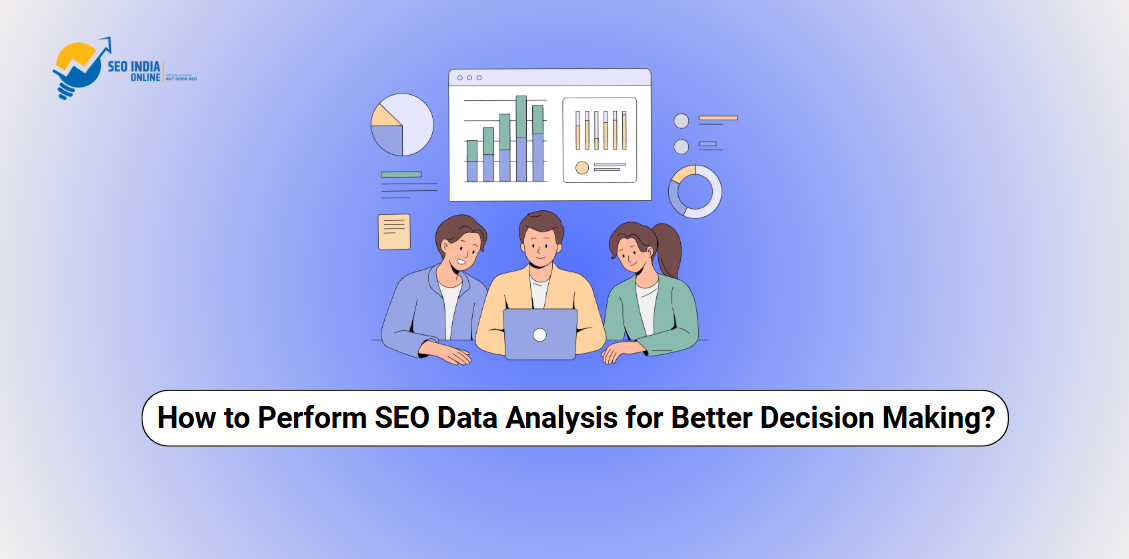
How to Perform SEO Data Analysis for Better Decision Making?

The process of assessing search engine data in order to analyze how your site is doing and to discover some growth opportunities is referred to as SEO data analysis. It entails examining such indicators as keyword positions, web traffic sources, click-through percentage rates, back-links, and page user action to understand what is performing efficiently and what has to be improved. This type of analysis is critical to marketers, business owners and to those involved in SEO- to determine trends, ROI and to scale up their strategy to get better results.

Digging into the correct data helps you to get out of working in a guesswork mode or basing decisions on guesses instead of the smart ones that will give out there. You can be optimizing some content, developing your keyword strategy or monitoring conversions, but with proper SEO analysis, all that effort you put in will be in line with real user behavior and what the search engines want.

What Is SEO Data Analysis?

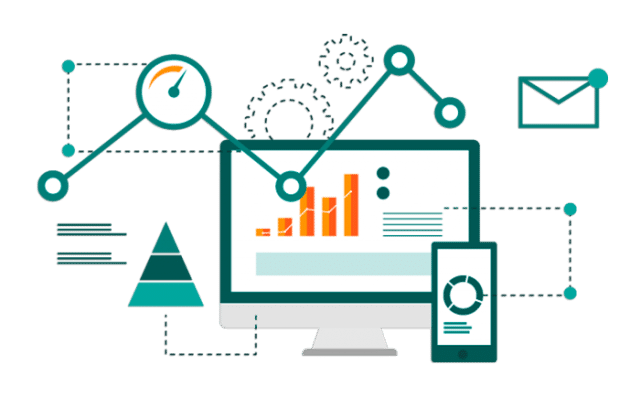
SEO data analysis entails collection, interpretation and visualisation of data with regard to how your site is performing at such locations as the search engines. It suggests monitoring the key metrics, such as search ranking, organic traffic and the bounce rate, the quantity of backlink and the click-through rate, and user activity to get an understanding of the efficiency of your SEO practices.

This study will assist in identifying trends, best practices and opportunities to enhance. With such insights, companies can make knowledgeable choices to become more visible, rank higher, and have more conversions. Data analysis in SEO consists of taking raw figures and turning them into effective strategies that put marketers and SEO specialists on the same path as users and the search engine ranking algorithms in pursuit of long-term growth in the online space.

Why Does SEO Data Analysis Matters for Decision Making?

SEO insights can be used to make intelligent, result-based decisions. It improves the precision of campaign planning showing what has worked in the past and where the gaps are. Through analyzing the keyword performance as well as user engagement, businesses can focus on keyword and higher-impact content that influences traffic and conversions.

This will make time and resources be channeled towards what is important. Through SEO data, it is also possible to better allocate the available budget by calculating which marketing channel presents the highest value. The best part of it is that it provides real-time clarity of what works and what does not and can be adjusted accordingly, on-the-fly. Teams are able to make confident, cost effective decisions based on data-driven clarity that underpins improved online performance.

Key Metrics to Track in SEO Data Analysis

When analyzing data in SEO, it is essential to monitor essential metrics to know how well things are going. Organic traffic indicates the number of the customers coming by means of the search engines. The ranking of keywords indicates the level of ranking of your content based on the targeted terms. Bounce rate depicts the number of users who do not interact showing content relevance. Conversion rate refers to the number of visitors who perform desirable actions, including, but not limited to signing up or buying. We will discuss each of these critical measures individually so that you get a better idea.

Organic Traffic: Source, Volume, and Trends

Organic traffic is traffic on your site that comes to you via the unpaid search engine results. When you analyse the source (search engines such as Google or Bing), the volume (the number of users in total) and the trend of this data over time, you can see how successful your SEO campaigns are in encouraging visitors. The Google Analytics and Search Consoles are additional tools that can provide in-depth reports on how the traffic is trending over devices, locations or the landing page. Following these trends will help you see seasonal changes, what effect algorithm changes will have and make strategic use of optimizations or content focus to meet expected trends.

Keyword Rankings: Changes, SERP Positions, Visibility

Keywords ranking describes the positions of your site on search engine result pages (SERPs) in relation to determined search terms. Following the ranking fluctuations can tell you how effective your SEO is. Monitoring SERP places will help you know whether your content is moving up the page 1 or down the page. The frequency and rank of keyword appearance are visible when the distinction actually measures. Tools such as SEMrush, Ahrefs, or Google Search Console offer the data on the performance of keywords and assist in optimizing strategies, pursuing new opportunities, and cutting the risks of losing competence in the relevant search queries.

Click-Through Rate (CTR): From Google Search Console

CTR is the percentage of the users that clicked the link to your site after viewing it on the search results page. Google search console provides CTR per query, per URL, and per device, so it is easy to see which pages or keywords get clicks and which ones users ignore. A low CTR with a high impression indicates that meta titles and descriptions should be improved or they are irrelevant. CTR optimization increases traffic without increasing rankings. Monitoring the CTR over time can also enable you to assess how well you’re SEO copywriting, SERP features and structured data improvements such as rich snippets are performing.

Bounce Rate & Time on Page: From GA4

Bounce rate and time on page can help understand engagement of users. Bounce rate can point at a content disparity mismatch or negative user experience and time on page can point at the positive user experience of the value and relevance of the content. GA4 also gives more insight through providing the engagement rate, scroll depth, and session duration. Such measures allow it to determine what pages have to be optimized, whether CTAs are functioning, and how to format their contents to be more easily retained, all of which will affect the overall SEO performance and conversions.

Conversion Rate from Organic: Track Goal Completions

Conversion rate of organic traffic gauge how many people take an intended action, such as filling out forms, signing up, or buying something, when they arrive through search engines. This indicator links SEO activities with business results. In GA4, you can configure a goal or an event and filter it based on traffic source and isolate organic conversions. When your conversion rate is high, it indicates your SEO is bringing the right people to the content and it matches their intention. Monitoring this will make it easier to justify the investment in SEO, maximize the pages with traffic and to optimize on the perspective of keyword targeting to increase ROI.

Backlink Profile: Quality and Quantity of Referring Domains

The presence of a good backlink profile communicates competence and belief to the search engines. It comprises the number of backlinks and the domain quality of the referrals. Backlinks can be analyzed in terms of domain authority, link diversity, anchor text, spam score with the help of such tools as Ahrefs or Moz. Good backlinks created by trustworthy sites raise the ranks and referral traffic. Observing your backlink profile, you also can get to know toxic backlinks that may negatively affect SEO, and find new sources to use to build links. The auditing of your approach to gathering links regularly will make certain that your distribution of links corresponds to long-term recognition, power, and search engine credibility.

Core Web Vitals & Page Speed: For Technical SEO Decisions

The Core Web Vitals Largest Contentful Paint (LCP), First Input Delay (FID), and Cumulative Layout Shift (CLS) are measurements that reflect the actual experience of users in your site. Together with page speed they directly influence rankings and user satisfaction. The tool has diagnostics provided by the search console Core Web Vitals report and Google PageSpeed Insights. Low conversion rate and increased bounce rate are caused by slow loading times or intuitive layouts. Evaluating these metrics, SEO specialists can improve technologically so that the usability gets improved, the engagement increases, and, what is more important, that it can comply with the focus of the Google algorithms on performance and page experience.

Step-by-Step: How to Perform SEO Data Analysis

Determine the direction in which you are going and are extremely significant when starting to analyze data in terms of SEO. This may involve the increasing of organic traffic, rating in certain keywords, or conversions. Once it becomes clear what the goals are, the appropriate data will be collected with the assistance of portals like Google Analytics, Google Search Console, as well as third-party SEO systems. Data segmentation is the next important step. It assists in disaggregation of parameters preferably by means of its source of traffic, gadget kind, area or landing page to reveal the tendencies and chances. To make more informed strategic decisions on SEO, let us walk through all the steps in a step-by-step manner.

Set Your Goals

Before getting into the data on SEO, it is worth having a clear definition regarding what is wanted to be achieved. Would you like to increase the traffic of organic content, efficient content, proper technical SEO, or even the conversion? The presence of a clear gauge of what you are attempting gives the definition of what data you collect and how you will interpret the outcome. To take an example, when your objective is to increase traffic, you will track search visibility and ranking of keywords. In case of technical performance, Core Web Vitals and site speed are prioritized. One way of organizing SEO strategies with business results is to set objectives that are measurable and can be accomplished. It makes every action or campaign you engage in significant.

Collect the Right Data

Proper SEO analysis requires correct data collection. Traffic, engagement, and conversion data can be measured with tools such as Google Analytics and Google Search Console. Add to that third party SEO tools, including Ahrefs, SEMrush, or Moz, to monitor backlinks, performance of your keywords, and competitors. Technical SEO problems can be identified with crawl tools such as Screaming Frog. Make sure that your data relates to all the aspects required, such as content, technical performance, and user behavior. Aggregate data provides an overarching perspective of your SEO environment and is the basis of good, goal-based insights.

Organize and Segment the Data

After you have the SEO information, be sure you categorize it into different relevatn categories. Break down into landing pages, keywords, devices, traffic sources and demographic of the audience. This segmentation assists in showing which content can show better on the mobile or the desktop view and similarly which keywords are bringing in more traffic based on geographical locations. Segmentation also goes a long way allowing clearer observation of user behavior and content performance in various contexts. Aggregating data successfully will help you see some pattern of data, highlight a problem area, and design your strategies specifically to each segment. Properly constructed data is essential towards making actionable conclusions and the best use of the SEO effects.

Identify Trends and Patterns

You have now segmented your data, and begin to identify some trends and patterns. Make sure to see the stability of organic traffic, increase of keywords ranking or engagement metrics. Moreover, identify losses, including pages decreasing in terms of their ranking or bounce rate. Early identification of these changes enables you to take action before they affect performance in any major ways. Trends can indicate what works and what does not work, as well as allow a prioritized focus on areas requiring critical attention. Seasonal trends or general improvements that can be relied on in future approaches can also be revealed in the analysis of historical data. Trend analysis can make your SEO campaign active and well-informed.

Interpret the Data

The interpretation fills the gap between data and decisions. Relate your insights to your initial objectives, e.g., assess whether a growth in traffic is resulting in more conversions or whether a better position is resulting in higher ROI. Do not just look at the vanity display such as impressions, or likes. Focus more on ROI-related metrics instead, like lead quality, revenue, engagement. Interpreting this data allows you to have the big picture and makes sure that your SEO work is properly aligned to the priorities of the business.

Make Data-Driven Decisions

Use your analysis to inform real changes. Update underperforming content with meta tags, new keywords, or optimized page loading speeds to give a good user experience. In case there are keywords with significant potential, amplify the content around them, or enhance taking links within them. Change those strategies depending on what the information shows, relocating budget, focusing on alternative subjects, or enhancing mobile friendliness. All activities need to be supported by obvious understanding. Data-based decision-making will make your SEO efforts narrow, streamlined, and goal-oriented as well as up to date with the latest search trends and the direction of your business.

Create Visual Reports for Teams or Clients

Visualisation of SEO data helps people to read and share. Make use of tools such as Google Looker Studio, Tableau, or dashboard functions in an SEO platform to develop transparent, straightforward reports. Performance snapshots, trend graphs, and KPI breakdowns should be made monthly to aid stakeholders in understanding progress in a short span of time and improvement areas. Visual reports are transparent, organize team members, and help when discussing strategy. When communicating team-level updates, whether internally or toward clients, frequent visual reporting keeps everyone in the know, and ensures that everyone remains focused on common objectives. Properly formulated, a report makes inert data meaningful.

Best Tools for SEO Data Analysis

The suitable tools to be used in analysing SEO data provide detailed information about the performance of a site. Google Search Console monitors the ranking of keywords, impressions, and technical problems. Google Analytics (GA4) checks the behavior of users, traffic sources, and conversions. Ahrefs is an all-purpose resource that gives information on back links, keywords, and competitor analysis. Collectively, the tools provide a whole picture of SEO wellness. Now, how will each of the tools help us better analyze and strategize?

Google Search Console: Keyword and CTR Data

The Google Search Console is necessary in order to track the presence of your site in the search results. It also gives comprehensive information on keyword searches, impressions, click through rates (CTR) and average search engine results page (SERP) positions. You are able to notice the query and page residents that result in the most traffic, so you may enhance content to be seen and connected with. It also warns about indexing problems, mobile usability problems and sitemap problems. With this information, SEO specialists will be able to set the focus of keywords, their meta description, and search engine compliance to get superior organic results.

Google Analytics (GA4): Traffic and Behavior Insights

GA4 provides very valuable insights into the behavior of users and flows. It monitors the visitor activity on your site in terms of pages and session, bounce rate, pages and conversion activities. You may segment by source, device, location, or behavior to know what fuels the most value. GA4 uses an event-first approach and permits in-depth user journey and engagement point tracking. The insights assist marketers in the measures of content performance, improvement of UX, and optimization of SEO in regards to business objectives corresponding to lead generation or conversion of sales.

Ahrefs / SEMrush / Moz: Backlinks, Keyword Data

Ahrefs, SEMrush, and Moz are the most popular third-party SEO tools to check in-depth backlink analysis, keyword rankings, and competitor performance. They assist in the monitoring of your site authority, detecting links that are toxic, and finding new backlinking opportunities. To conduct keyword research, such tools provide information about the number, difficulty, and SERP features. Competitor gap analysis assists in the identification of missed opportunities. What makes them useful in strategic planning is their detailed dashboards and alerts, which provide marketers with an in-depth integral picture of off-page SEO, ranking progress, and content potential with multiple search terms.

Looker Studio/Tableau/Power BI: Data Visualization

Data visualization tools such as Looker Studio, Tableau, and Power BI pages turn raw SEO data into understandable interactive dashboards and reports. You can combine third party and GA4, Search Console data on these platforms. Graphs and charts can be customized to visualize trends, KPIs and performance levels. This facilitates the analysis of search engine optimization complex data by teams and clients to check progress and make the right decisions. Visual reporting also makes the flow of communication smoother, improves transparency and the data-backed approaches as well.

Screaming Frog / Sitebulb: Site Audits and Technical SEO

Screaming Frog and sitebulb are useful tools that support a complete site audit and technical SEO potential issues. They crawl your site and give you reports on dead links, redirect chains, duplicate content, lack of meta tags and site structure. These observations aid in discovering issues that can interfere with indexing or low page experience. The two tools provide visualizations such as crawl maps and performance charts to enable findings to be executed. By using Screaming Frog or Sitebulb regularly, your web site will remain search google friendly and technically compliant.

Conclusion

To summarize, data analysis is not all about following numbers per se in SEO work but about gaining visibility and making better decisions. Monitoring the keywords ranking, user behavior, traffic sources, and technical issues consistently helps you to unveil the crucial pieces of knowledge leading to the performance. Constant reviewing will enable you to change swiftly, make decisions about priorities and keep up with business directives. No matter what area you are focusing on—traffic, conversions, or content optimization—data makes your strategy realistic. Use what you have learned and act. Are you ready to super-charge your SEO? Begin with smarter data now, or partner with the best SEO Company in India to turn insights into real results.

Posted in SEO

Top 10+ Proven Strategies to Boost Your Automotive SEO

In today’s digital-first market, every car dealership, auto repair shop, or vehicle rental business needs more than just a website. You need online visibility. When someone searches for “car dealer near me” or “auto service in [City],” is your business listed in the top results? If not, you’re losing potential customers to competitors who are investing in automotive SEO.

Automotive SEO helps your website appear prominently in search engine results when people are looking for the services you offer. In this updated guide, we’ll explore strategic methods to help your automotive business rank better, attract more traffic, and convert that traffic into real-world leads.

What is Automotive SEO?

Automotive SEO is the process of optimizing your website to improve visibility for auto-related search queries. Whether you’re selling vehicles, offering car repairs, or running a rental service, SEO ensures your business shows up when someone searches for relevant services online.

A holistic SEO approach works best. That means combining Local SEO to reach nearby customers, keeping your Google Business Profile (GBP) updated with accurate info, and sharing real customer reviews to build trust. With the rise of tools like AI Search Overview, it’s also important to create clear, useful content that answers common questions quickly.

12 Proven Automotive SEO Strategies to Drive Results

1. Enhance Your Website Experience

Your website functions as your digital showroom. A slow, outdated, or hard-to-navigate site can cost you leads. Ensure your website loads quickly, features simple navigation, and is fully responsive across all devices. More than 65 percent of automotive searches now happen on mobile, making mobile performance crucial to SEO success.

2. Create High-Value, Localized Content

Your content should address what your customers are searching for. Think blog topics like “Best SUVs for Indian Roads” or “When to Replace Your Car Battery in [City].” Localized content that answers real user queries builds authority and improves engagement, both of which boost rankings.

3. Optimize Your Google Business Profile

Claim and optimize your Google Business Profile to improve visibility in local search and map results. Include accurate business information, high-quality images, and regular updates. Encourage satisfied customers to leave reviews, and always respond professionally to all feedback.

4. Implement Structured Data for Auto Listings

Use schema markup tailored to automotive businesses such as AutoDealer schema. This helps Google better understand and display your listings in search results, including vehicle inventory, pricing, and reviews, which can increase your click-through rate.

5. Build Local Landing Pages

If your business serves multiple cities or regions, create dedicated landing pages for each area. A page like “Car Repair Services in Delhi” helps you rank for localized searches. Include unique content for each page, focusing on services offered, local testimonials, and regional contact info.

6. Earn Backlinks from Local Sources

Build authority with backlinks from reputable local sources such as news websites, community blogs, and event pages. Partner with local auto events or sponsorships to get featured on their websites. These local backlinks reinforce trust and relevance in search engines.

7. Generate and Manage Customer Reviews

Positive reviews improve both SEO and customer trust. Ask happy customers to leave reviews on your Google profile and other industry directories. Always respond politely, even to negative reviews, as engagement can improve your local relevance and overall brand image.

8. Use AI Tools for Smarter Content Planning

AI-powered tools like ChatGPT, SurferSEO, and MarketMuse help you create better content, faster. Use them to build content outlines, generate keyword suggestions, and improve on-page SEO. AI also helps you monitor trends and adapt quickly to changes in user behavior and algorithms.

9. Make Your Site Fully Mobile-Friendly

With the majority of users browsing on mobile, your site must perform flawlessly on smaller screens. Use a responsive design that adjusts layout and functionality based on device type. A mobile-optimized site improves dwell time, reduces bounce rates, and helps you rank higher.

10. Replace Sliders with Clear Call-To-Actions

Homepage sliders often slow down websites and confuse visitors. Replace them with a simple, direct message and a clear call-to-action like “Book Your Free Test Drive Today” or “Schedule Your Car Service Now.” Clear messaging converts better and loads faster.

Final Thoughts

Automotive SEO is not just a technical strategy; it’s a long-term business investment. By improving your website’s user experience, delivering useful content, leveraging local SEO, and staying current with Google’s algorithm updates, you give your automotive business a clear edge over the competition.

Keep your strategy flexible, monitor your progress consistently, and focus on what your customers need. With the right approach, your business will not only gain visibility but also earn the trust and loyalty of car buyers and service seekers in your area.

Ready to shift your SEO into high gear? These strategies are your roadmap to higher rankings and long-term success. Contact best SEO Company India to learn more about Automotive SEO.

Website Optimization – A Brief Technical Guide

In today’s competitive digital landscape, ranking at the top of search engine results is no longer optional, it’s essential. Your website is the digital face of your brand, and if it’s not optimized, you’re likely missing out on valuable traffic, leads, and revenue. Website optimization helps ensure your site is not just visible, but also effective at converting visitors into customers. In this updated guide, we’ll explore how modern website optimization works, why it’s crucial, and what steps you can take to stay ahead in 2025.

What is Website Optimization?

Website optimization is the process of improving your website to make it more effective for both users and search engines. It involves refining elements like page speed, mobile responsiveness, content quality, user experience, and SEO structure so your site performs better in search results and keeps visitors engaged. The ultimate goal is to drive more traffic, increase conversions, and ensure that users can easily find what they’re looking for, regardless of the device or platform they’re using.

Why Website Optimization Still Matters

Search engines have grown smarter, but the fundamentals haven’t changed—better-optimized websites perform better in rankings and ROI. Here’s why you can’t ignore website optimization in 2025:

1. Visibility and Brand Trust:

Studies show that more than 90% of searchers never go past page one of Google. A well-optimized website ensures you stay visible, attract quality leads, and build trust with users who are actively searching for your services.

2. Outperforming Competitors:

Your competitors are constantly improving their online presence, and if you’re not optimizing, you’re falling behind. By focusing on faster load times, better user experience, and SEO best practices, you can rank higher in search results and attract more qualified traffic. A well-optimized site gives you a clear edge, helping you stay ahead and win over potential customers before your competitors do.

3. Higher Conversions and ROI:

Website optimization plays a key role in driving results. When your site is fast, mobile-friendly, and easy to navigate, visitors are more likely to take significant actions. Whether it’s submitting a form, making a purchase, or booking a consultation, an optimized website turns more traffic into measurable business outcomes.

Key Elements to Optimize in 2025

AI & Automation

In 2025, AI is a core part of successful website optimization. From AI-generated content using tools like ChatGPT to strategic content planning with platforms such as SurferSEO or MarketMuse, automation streamlines workflows and improves accuracy. For technical audits, advanced crawlers like Screaming Frog and Sitebulb offer deep insights. Leveraging these tools isn’t just a trend; it’s essential for staying ahead of the competition.

Technical SEO

Technical SEO is a critical component of website optimization. It ensures your site is accessible, crawlable, and indexable by search engines. From fixing broken links and optimizing XML sitemaps to configuring robots.txt and using HTTPS, these technical elements help improve site structure and performance. When your website is technically sound, it loads faster, ranks better, and provides a smoother experience for users. These are key goals of effective website optimization.

Content Optimization

Content optimization is at the heart of website optimization. It involves creating high-quality, user-intent-focused content that resonates with both search engines and readers. By using structured data like Schema.org, you can enhance how your pages appear in search results. Incorporating NLP-based keyword research and topic clustering helps ensure your content is well-organized, relevant, and more likely to rank. This makes your website more discoverable and engaging.

Mobile-First Experience

With nearly 65% of global website traffic coming from mobile devices, it’s essential to ensure your website is responsive, loads quickly, and offers easy navigation across all screen sizes. A mobile-friendly design directly supports website optimization by improving user experience and meeting Google’s mobile-first indexing standards.

Core Web Vitals

Google’s page experience metrics are essential for modern website optimization. Focus on improving LCP (loading), FID (interactivity), and CLS (visual stability) to enhance user experience and maintain strong search rankings.

Conversion Rate Optimization (CRO)

As a key part of website optimization, CRO focuses on turning more visitors into customers. By using heatmaps, A/B testing, and user behavior analysis, you can fine-tune calls to action, improve form layouts, and streamline landing pages to ensure your optimized site doesn’t just attract traffic but also converts it effectively.

Getting Started: A Simplified Optimization Workflow

1. Run a Comprehensive Audit

Begin by evaluating your website’s current performance. Use tools like Google Search Console to monitor indexing issues, Core Web Vitals, and mobile usability. Platforms like SEMrush and Ahrefs provide detailed insights into keyword rankings, backlink profiles, and site health. These audits help you uncover technical errors, content gaps, and opportunities to enhance your site’s SEO and user experience.

2. Set Clear KPIs

Before making changes, define what success looks like. Align your optimization goals with measurable business objectives such as increased organic traffic, higher conversion rates, reduced bounce rates, or improved lead quality. Setting clear key performance indicators (KPIs) ensures your efforts are focused and allows you to track progress effectively over time.

3. Implement Targeted Fixes

Based on your audit findings, start applying strategic updates. This can include compressing large images to boost loading speed, implementing lazy loading to improve performance, fixing broken links, adding schema markup for enhanced search visibility, and restructuring header tags to improve content hierarchy. Prioritize fixes based on impact and complexity, focusing first on changes that deliver the greatest return.

4. Monitor & Iterate

Website optimization is not a one-time effort. It requires continuous improvement. Monitor your KPIs regularly, track user behavior with tools like Google Analytics and Hotjar, and stay updated with the latest algorithm changes from Google. Run A/B tests, refine your strategies, and remain flexible to adapt to evolving user expectations and SEO best practices.

By following this workflow, you build a solid foundation for long-term website success, ensuring your site is not only visible but also valuable to both search engines and real users.

Final Thoughts

Website optimization is more important than ever in 2025. With Google’s algorithm updates becoming more sophisticated and user behavior constantly evolving, a strong optimization strategy ensures your site remains competitive, visible, and profitable. If you’re serious about attracting high-quality traffic and converting it into revenue, now is the time to invest in smart, data-driven optimization.

SEO India Online – SEO Company in India, specializes in comprehensive website optimization solutions. From technical audits to content strategy, we help businesses improve speed, usability, and search visibility. This ensures your website performs at its best and drives measurable results.

Posted in SEO

Top SEO Companies of 2026 – List of SEO Agencies

As search algorithms evolve and AI-driven platforms like ChatGPT and Google Gemini shape how users discover information, businesses need expert SEO partners more than ever. The top SEO companies of 2026 stand out for their ability to adapt, innovate, and deliver consistent results across industries. From ecommerce to B2B, these SEO agencies offer tailored solutions including technical SEO, content strategy, local optimization, and performance marketing. Backed by proven track records and global client success, these firms are trusted by startups, enterprises, and agencies alike. If you’re looking to grow visibility, traffic, and ROI in a competitive digital landscape, the following SEO companies have earned their place at the top with transparent practices and measurable outcomes.

Here are the top SEO companies for 2026

Company Specialty
EZ Rankings Scalable solutions, performance marketing, white-label partnerships
SEO India Online Affordable SEO, AI-integrated strategies, no long-term contracts
Thrive Internet Marketing Agency Transparent SEO strategies, data-driven growth, client-focused results
WebFX Proprietary tech (MarketingCloudFX), data-driven ROI, full-funnel strategy
Coalition Technologies Ecommerce SEO, conversion-focused design, enterprise strategies
Victorious SEO-only agency, transparent reporting, strategy-led execution
Ignite Visibility Enterprise SEO, predictive forecasting, performance-driven campaigns
Siege Media Content-led SEO, scalable link building, high-growth strategies
Bruce Clay Inc. SEO training, white-hat SEO, proprietary tools (SEOToolSet)
OuterBox Ecommerce SEO, custom web dev, full-service digital strategy

1. SEO India Online

SEO India Online is one of the best SEO company in India, specializing in affordable and performance-driven SEO solutions. With over six years of industry experience and 500+ campaigns delivered, the company offers customized strategies focused on boosting keyword rankings, organic traffic, and qualified leads. Their services cater to both startups and established brands, covering National SEO, Local SEO, Ecommerce SEO, Google Map optimization, content marketing, and AI-integrated strategies built for modern search environments like ChatGPT and Gemini.

The agency has helped businesses across industries such as education, healthcare, real estate, law, e-commerce, and B2B achieve measurable growth online. With a client base spanning India, the USA, UK, UAE, Australia, and Canada, SEO India Online is known for its transparent process, data-backed strategies, and strong client retention. They offer flexible, cost-effective packages starting at $199 per month with no long-term contracts, making them a reliable partner for sustainable digital growth.

Key Details

  • Website: http://182.77.48.223/dev/seoindiaonline/
  • Email: contactus@seoindiaonline.com | sales@seoindiaonline.com
  • Phone: +91 9810572367 | +91 9810572967
  • Head Office: India
  • Services Offered: SEO, Local SEO, Ecommerce SEO, Google Map SEO, Content Marketing, PPC, Online Reputation Management, Website Development
  • Industries Served: E-commerce, Education, Healthcare, Legal, Real Estate, Travel, B2B
  • Client Locations: India, USA, UK, UAE, Australia, Canada

2. EZ Rankings –

EZ Rankings is a leading SEO Company in India, recognized for delivering comprehensive and result-driven online marketing solutions. With over a decade of experience and a strong portfolio of 16,000+ successful projects, the agency offers tailored strategies to help businesses improve their visibility, traffic, and online conversions. Their services span across SEO, paid advertising, social media marketing, web design, and development, with a strong focus on innovation, data, and measurable ROI.

Serving clients in over 28 countries, including the USA, UK, Canada, Australia, and India, EZ Rankings has earned a reputation for its transparent processes, customized campaigns, and client-centric approach. The agency caters to a wide range of industries, including e-commerce, healthcare, law, education, travel, and SaaS. Known for its flexible packages and white-label services, EZ Rankings is a reliable partner for businesses, marketing teams, and agencies looking to scale efficiently and sustainably in competitive markets.

Key Details

  • Website: https://www.ezrankings.com
  • Email: contactus@ezrankings.com
  • Phone: +91 9560133711 | +1 855-763-0320
  • Head Office: India
  • Services Offered: SEO, Local SEO, Ecommerce SEO, Paid Marketing (Google Ads, Social Media Ads), Web Design and Development, Social Media Marketing, Online Reputation Management, White Label SEO
  • Industries Served: E-commerce, Healthcare, Education, Legal, Travel, SaaS, Real Estate, B2B
  • Client Locations: India, USA, UK, Canada, Australia, UAE, and other international markets
  • Specialty: Scalable solutions, performance marketing, and white-label partnerships

3. Thrive Internet Marketing Agency

Thrive Internet Marketing Agency is a top-rated SEO company based in the United States, known for delivering tailored, results-oriented SEO solutions that help businesses grow sustainably in competitive markets. Established in 2005, Thrive brings nearly two decades of experience in driving measurable growth through white-hat SEO practices, AI-integrated strategies, and data-backed decision-making. From on-page and technical SEO to link building and local optimization, Thrive’s comprehensive SEO services are designed to improve visibility, organic traffic, and lead quality.

With clients across the USA, Canada, UK, Australia, and other global regions, Thrive has built a reputation for transparency, consistent communication, and high-performance campaigns. The agency works with businesses of all sizes—from local startups to global enterprises—across industries like ecommerce, healthcare, education, legal, real estate, and SaaS. Thrive’s team of experts crafts strategies aligned with the latest search engine algorithms, helping clients achieve long-term success without shortcuts or guesswork.

Key Details

  • Website: https://thriveagency.com
  • Email: info@thriveagency.com
  • Phone: +1 866-908-4748
  • Head Office: USA
  • Services Offered: SEO, Local SEO, Technical SEO, Link Building, PPC, Web Design and Development, Content Marketing, Social Media, Reputation Management
  • Industries Served: E-commerce, Healthcare, Education, Legal, Real Estate, SaaS, Finance, B2B
  • Client Locations: USA, Canada, UK, Australia, and other international markets
  • Specialty: Transparent SEO strategies, data-driven growth, and client-focused results

4. WebFX

WebFX is a globally recognized SEO company headquartered in the United States, known for delivering data-driven strategies that help businesses improve online visibility and drive sustainable growth. With over 25 years of industry experience and a track record of generating more than $3 billion in client revenue, WebFX specializes in custom SEO solutions backed by advanced technology and expert human insight. Their services include on-page SEO, technical SEO, local SEO, link building, content development, and AI-powered SEO tools.

The agency serves clients of all sizes—from small local businesses to Fortune 500 companies—across a wide range of industries, including ecommerce, healthcare, finance, legal, B2B, and SaaS. With a client base spanning the USA and global markets, WebFX is trusted for its transparent reporting, ROI-focused strategies, and proprietary marketing platform, MarketingCloudFX. Their team of 500+ digital experts is dedicated to helping clients achieve long-term rankings and measurable business outcomes through ethical SEO practices.

Key Details

  • Website: https://www.webfx.com
  • Email: info@webfx.com
  • Phone: +1 888-601-5359
  • Head Office: USA
  • Services Offered: SEO, Local SEO, Technical SEO, Link Building, Content Marketing, PPC, Web Design and Development, Amazon SEO, Social Media Marketing, Email Marketing
  • Industries Served: E-commerce, Healthcare, Finance, Legal, Education, B2B, SaaS, Real Estate
  • Client Locations: USA and global markets
  • Specialty: ROI-focused SEO strategies, proprietary tech platform, and scalable enterprise solutions

5. Coalition Technologies

Coalition Technologies is a top-performing SEO company based in the United States, widely recognized for delivering advanced search engine optimization solutions that combine creativity, technology, and data. Founded in 2009, the agency has helped hundreds of clients achieve top rankings, increased traffic, and revenue growth through customized strategies tailored to their unique business goals. With a strong focus on technical SEO, ecommerce SEO, and content-driven campaigns, Coalition Technologies leverages proprietary tools and in-depth analysis to ensure consistent, long-term success.

The agency serves a global clientele across industries such as ecommerce, legal, healthcare, B2B, SaaS, education, and finance. Coalition Technologies is known for its transparent reporting, in-house development capabilities, and rigorous quality standards. Its team of 250+ professionals—strategists, developers, designers, and SEO experts—work collaboratively to drive real, measurable impact for clients of all sizes, from startups to enterprise brands.

Key Details

  • Website: https://www.coalitiontechnologies.com
  • Email: sales@coalitiontechnologies.com
  • Phone: +1 310-827-3890
  • Head Office: USA
  • Services Offered: SEO, Technical SEO, Ecommerce SEO (Shopify, BigCommerce, Magento), PPC, Web Design and Development, Content Marketing, Email Marketing, Social Media Marketing
  • Industries Served: E-commerce, Healthcare, Legal, Education, B2B, SaaS, Finance, Real Estate
  • Client Locations: USA, Canada, UK, Australia, and global markets
  • Specialty: Technical SEO, ecommerce expertise, in-house development, and transparent reporting

6. Victorious

Victorious is an award-winning SEO company headquartered in San Francisco, USA, known for delivering transparent, ROI-driven SEO campaigns that align with business objectives. Focused exclusively on search engine optimization, Victorious has built its reputation by applying data-led strategies, advanced keyword targeting, and technical expertise to help clients achieve long-term organic growth. The agency emphasizes collaboration, clarity, and performance in every campaign, making SEO accessible and impactful for businesses of all sizes.

Specializing in national and local SEO, link building, and on-site optimization, Victorious serves clients across industries such as SaaS, e-commerce, real estate, legal, healthcare, and B2B. Their proprietary SEO methodology combines rigorous audits with clear execution plans and real-time reporting. With a global client base and a commitment to white-hat practices, Victorious is trusted by startups and enterprise brands alike to deliver results that matter.

Key Details

  • Website: https://victoriousseo.com
  • Email: info@victoriousseo.com
  • Phone: +1 415-621-9830
  • Head Office: USA
  • Services Offered: SEO, Local SEO, Technical SEO, Keyword Research, Link Building, On-Page Optimization, SEO Audits, Content Strategy
  • Industries Served: SaaS, E-commerce, Legal, Real Estate, Healthcare, B2B, Education
  • Client Locations: USA, Canada, UK, Australia, and global markets
  • Specialty: SEO-only agency, transparent reporting, and strategy-led execution

7. Ignite Visibility

Ignite Visibility is a leading SEO company based in San Diego, California, known for its strategic and ROI-focused approach to digital marketing. Founded in 2013, Ignite has quickly grown into one of the most respected names in the SEO industry, managing over 150 clients and recognized multiple times by Clutch and Inc. 5000. The agency offers a full suite of SEO services, including technical SEO, local SEO, international SEO, link building, and content strategy, all customized to help businesses dominate search rankings and drive consistent traffic growth.

Ignite Visibility serves businesses across the United States and internationally, with clients in sectors such as e-commerce, healthcare, legal, education, B2B, SaaS, and finance. Known for its proprietary forecasting system and transparent reporting dashboards, Ignite prioritizes performance metrics and clear communication. Their team of 100+ digital experts provides tailored campaigns for brands ranging from startups to Fortune 100 companies, making Ignite a trusted partner for measurable and sustainable growth.

Key Details

  • Website: https://www.ignitevisibility.com
  • Email: info@ignitevisibility.com
  • Phone: +1 619-752-1955
  • Head Office: USA
  • Services Offered: SEO, Local SEO, Technical SEO, International SEO, PPC, Conversion Rate Optimization, Content Marketing, Social Media Marketing, Email Marketing, Amazon Marketing
  • Industries Served: E-commerce, Healthcare, Education, Legal, SaaS, B2B, Finance, Real Estate
  • Client Locations: USA and global markets
  • Specialty: Data-driven SEO strategies, enterprise SEO, and predictive ROI forecasting

8. Bruce Clay Inc.

Bruce Clay Inc. is a pioneering SEO company based in California, USA, widely regarded as one of the founding forces behind ethical and effective search engine optimization. Established in 1996, the agency brings over two decades of industry expertise, offering strategic SEO solutions grounded in best practices and guided by a deep understanding of search engine algorithms. The company’s services include technical SEO, site audits, keyword strategy, SEO training, and content optimization—designed to deliver sustainable rankings and measurable results.

Bruce Clay Inc. serves clients across the globe, ranging from small businesses to Fortune 500 brands in industries such as healthcare, legal, ecommerce, B2B, education, and technology. The agency is known for its emphasis on white-hat SEO, robust training programs, and proprietary tools like the SEOToolSet®. With a strong focus on long-term value, Bruce Clay Inc. remains a trusted advisor for businesses seeking stability, transparency, and excellence in SEO execution.

Key Details

  • Website: https://www.bruceclay.com
  • Email: info@bruceclay.com
  • Phone: +1 805-517-1900
  • Head Office: USA
  • Services Offered: SEO, Technical SEO, SEO Audits, Content Optimization, SEO Training, PPC, Web Analytics, Social Media Marketing
  • Industries Served: E-commerce, Healthcare, Legal, Education, B2B, Technology, Finance
  • Client Locations: USA, Australia, India, Japan, and global markets
  • Specialty: SEO training, white-hat SEO practices, and enterprise-grade optimization tools

9. OuterBox

OuterBox is a full-service SEO company and digital marketing agency based in Akron, Ohio, known for its deep specialization in ecommerce SEO and custom website development. Founded in 2004, OuterBox has over 20 years of experience helping businesses grow their online presence through data-driven SEO campaigns, technical site audits, keyword strategies, and revenue-focused solutions. The agency is particularly renowned for its ability to scale ecommerce businesses using tailored SEO strategies that improve visibility, traffic, and online conversions.

With hundreds of clients across the U.S. and internationally, OuterBox works with both B2B and B2C brands across industries including manufacturing, healthcare, automotive, legal, and fashion. Their in-house team of SEO strategists, developers, and content marketers ensures end-to-end project execution with measurable results. OuterBox is especially trusted by businesses running on platforms like Shopify, Magento, WooCommerce, and BigCommerce, offering both marketing and web development under one roof.

Key Details

  • Website: https://www.outerboxdesign.com
  • Email: sales@outerboxdesign.com
  • Phone: +1 866-647-9218
  • Head Office: USA
  • Services Offered: SEO, Ecommerce SEO, B2B SEO, Technical SEO, Website Design, Web Development, PPC, Conversion Rate Optimization
  • Industries Served: E-commerce, B2B, Manufacturing, Automotive, Healthcare, Legal, Fashion, Retail
  • Client Locations: USA and global markets
  • Specialty: Ecommerce SEO, custom website development, and integrated digital strategy

10. Siege Media

Siege Media is a highly respected SEO company headquartered in Austin, Texas, known for its content-led approach to organic growth. Founded in 2012, the agency specializes in combining advanced SEO techniques with high-quality, link-worthy content that drives rankings, traffic, and authority. Siege Media is particularly known for its expertise in content marketing, on-page optimization, and scalable link acquisition strategies, making it a go-to partner for businesses seeking long-term SEO performance.

The agency primarily works with mid-market and enterprise-level clients across industries such as SaaS, fintech, ecommerce, healthcare, and B2B. With offices in Austin, San Diego, and New York, and a fully distributed team, Siege Media serves clients across the U.S. and international markets. Their proprietary SEO frameworks, data-informed content strategy, and consistent delivery have helped brands achieve significant organic growth without relying on paid channels.

Key Details

  • Website: https://www.siegemedia.com
  • Email: contact@siegemedia.com
  • Phone: Not publicly listed (contact via website form)
  • Head Office: USA
  • Services Offered: SEO, Content Marketing, Link Building, On-Page SEO, Keyword Strategy, Technical SEO
  • Industries Served: SaaS, E-commerce, Fintech, B2B, Healthcare, Education, Technology
  • Client Locations: USA and global clients
  • Experience: 10+ years in SEO and content marketing
  • Specialty: Scalable content-led SEO, authoritative link building, and high-growth strategies

How to Choose the Best SEO Agency for Your Business in 2026

Choosing the right SEO agency can make or break your digital success. With hundreds of options and endless promises, how do you know which agency truly aligns with your goals? In 2026, it’s not just about rankings. It’s about finding a strategic partner who understands your industry, adapts to search trends, and focuses on long-term growth.

Here is a step-by-step guide to help you make an informed decision:

Define Your Goals Clearly

Before reaching out to any SEO agency, take the time to outline what you’re hoping to accomplish through search engine optimization. Are you a local business aiming to attract foot traffic through local SEO? Are you an ecommerce brand looking to scale product visibility and boost online sales? Or perhaps your main focus is generating qualified leads through increased organic visibility? Whatever your objectives may be, clearly defining them will make it much easier to identify an agency that specializes in the specific type of SEO you need. When you understand your goals, you’re better equipped to evaluate strategies, set realistic expectations, and choose a partner that can align their expertise with your desired outcomes.

Look for Industry Experience

Not all SEO strategies work the same across industries, which is why choosing an agency with relevant experience can give you a major advantage. An SEO company that has worked with businesses similar to yours, whether in healthcare, SaaS, education, legal, or ecommerce, will already understand the nuances of your market, target audience behavior, and competitive landscape. This industry-specific insight allows them to develop more effective strategies, content plans, and keyword targeting from the very beginning. When evaluating potential partners, don’t hesitate to ask for industry-related case studies or examples of past campaigns. Seeing proven results in your niche gives you confidence that the agency can replicate success for your business as well.

Review Their Website Performance

An SEO agency’s own website is a direct reflection of its capabilities. If they can’t effectively optimize their own online presence, it raises questions about how well they’ll manage yours. Start by exploring their blog to see if they publish valuable, optimized content that aligns with current SEO best practices. Check the website’s loading speed, mobile responsiveness, and overall user experience. These are fundamental elements of SEO, and a professional agency should excel in them. Additionally, run a quick search for keywords such as “best SEO agency” or “SEO services in [your country]” to see if their site ranks on Google. Agencies that rank for competitive keywords are often the ones who practice what they preach.

Explore Client Testimonials & Retention

One of the most reliable ways to gauge the credibility of an SEO company is by reviewing what their existing or past clients have to say. Positive testimonials and a strong retention rate indicate consistent performance and trustworthy service. Look for verified reviews on trusted platforms like Clutch, G2, or Google, these typically reflect authentic feedback from real clients. Pay attention to how long clients have worked with the agency, as long-term partnerships suggest satisfaction and ongoing results. It’s also helpful to find testimonials from businesses that are similar to yours in size or industry. This not only gives insight into the agency’s expertise but also reassures you that they can deliver results tailored to your business needs.

Understand Pricing & Packages

When choosing an SEO agency, it’s important to understand how their pricing works and what’s included in each SEO package. Some agencies offer fixed monthly plans that cover standard services, while others provide customized strategies based on your specific goals and industry. Carefully review what each plan offers, such as technical audits, content creation, link building, or local SEO, to ensure it aligns with your needs and budget. Keep in mind that the lowest price doesn’t always translate to the best value. Effective SEO takes time, expertise, and consistent effort. It’s better to invest in a well-rounded strategy that delivers measurable ROI rather than chasing the cheapest option and risking poor results or wasted resources.

Check Transparency & Reporting

Transparency is a crucial factor when selecting from the top SEO companies for your business. A trustworthy agency will keep you informed at every stage through regular updates and clear, data-backed performance reports. These should include essential metrics like organic traffic growth, keyword rankings, lead generation, and overall campaign progress. Top SEO companies typically use reliable tools such as Google Analytics, Google Search Console, or custom dashboards to provide accurate, real-time insights. Most importantly, the information should be presented in a clear and straightforward manner, without confusing jargon or vague explanations. When an agency is open about what’s working, what needs improvement, and how they plan to optimize your strategy, it builds confidence and ensures accountability.

Posted in SEO

SEO is definitely not dead in 2022: The Road Ahead for Web Search

Every year, someone out there says, “SEO is dead.” Honestly, we’ve heard it so many times it’s almost funny. But tell you from Experience—SEO in 2025 is very much alive. It’s just taken a new shape. If you run a business, manage a website, or write content, you already know how fast things change online. But one thing hasn’t changed: people still search. And where there are searches, there’s a need for good SEO.

Let’s talk about what SEO looks like in 2025. This isn’t about stuffing keywords or chasing backlinks like we did a decade ago. It’s about showing up where your audience is, speaking their language, and giving them something worth their time.

Why People Think SEO Is Dead

The idea that SEO is dead usually comes from frustration. You used to rank well and then suddenly dropped. Your traffic dipped after a Google update. Or you’ve heard about AI doing everything now, wondering if you’re wasting time writing content.

Here’s the thing: SEO isn’t dead. Bad SEO is.

The old tricks don’t work anymore. Google’s smarter. Users are pickier. And competition is more brutal. That’s not a death—it’s a challenge. And we’ve always been up for that.

What’s Changed in SEO (And What You Should Care About)

  1. AI-Powered Search

With AI now a massive part of how Search works, you can’t just write for bots anymore. Search engines understand the context better. That means your content makes sense and offers something tangible. It’s not about keyword density. It’s about meaning.

  1. Search Isn’t Just on Google

Let’s be real—people are searching everywhere now. YouTube, Reddit, and even Instagram. If you’re not thinking beyond Google, you’re missing out. If you run a food blog, for example, you might get more traffic from Pinterest than from a traditional search engine.

  1. Voice Search and AI Chatbots

“Hey Siri, where’s the best pizza near me?” You’ve probably said something like that. Voice search is growing, and so are AI-powered assistants. If your content doesn’t answer questions clearly and naturally, it won’t show where people are looking.

  1. Featured Snippets and No-Click Searches

More and more users get their answers right on the search page. So you might not get a click, but you still need to be visible. Think FAQ sections, short summaries, and direct answers.

  1. Content With Real Value

Google now looks for content that shows Experience, expertise, authority, and trust. It’s not enough to be informative—you need to be real. Share your experiences. Use your voice. People can tell when content is just written to hit a word count.

Our Experience in the SEO space

It was a lot simpler when we started working on SEO years ago. Write a blog, add keywords, get a few backlinks, and watch your site climb. Today? It takes way more thought and effort. But the results are worth it.

We’ve worked with clients whose websites barely showed up on page five. After a few months of solid content, fundamental SEO strategies, and patience, they’re now on the first page—and getting sales, not just clicks.

The biggest lesson we’ve learned? Don’t chase the algorithm. Focus on your audience. Understand what they’re searching for and how they ask for it. The rest follows.

What You Should Do Differently Now

If you’re still stuck in the SEO rules of 2015, it’s time to change things up. Here’s what we do now that works better:

  1. Write Like You’re Talking to a Friend

Forget the robotic tone. People don’t want to read content that sounds like a machine wrote. Use your voice. Share your thoughts. Be real.

  1. Be Present on Multiple Platforms

If you’re writing content, think about how you can repurpose it. A blog can become a short video. A podcast can be turned into a how-to article. The more ways you show up, the better.

  1. Think About Search Intent

Why is someone searching that keyword? What do they want to know or do? Match your content to that. Don’t just try to rank—try to help.

  1. Use Simple Formatting

Short paragraphs. Bullet points. Clear subheadings. Your content should be easy to scan. People don’t read every word—they scan first. Make it easy for them.

  1. Keep an Eye on Trends

We stay updated, not because we’re obsessed with Google updates, but because we want to remain useful. Whether it’s a new type of search result or a change in how mobile results appear, we watch how users respond and adjust from there.

The Role of Keywords in 2025

Yes, keywords still matter. But not like before. Now, it’s about using natural language and covering topics fully. One good piece that answers several related questions will always do better than ten short posts stuffed with keywords.

We focus on topics, not just terms. Think clusters of content. If someone searches for “how to start a podcast,” they’ll probably also want to know about equipment, hosting platforms, and editing tips. One solid page can cover all of that.

Your Website Still Matters

All the content in the world won’t help if your website is slow, clunky, or hard to navigate. Site speed, mobile-friendliness, and clear structure still play a huge role. If users can’t find what they’re looking for, they’ll leave. And Google notices.

Ensure your site loads quickly, works on phones and leads people to the answers they came for. And don’t forget your technical SEO—title tags, meta descriptions, image alt text. It all adds up.

SEO and AI Content

You’ve probably seen the rise in AI-generated content. Some of it is helpful. Some of it feels empty. We’ve tested a few tools ourselves. They’re suitable for ideas and outlines. But when it comes to making content that feels real? That still needs a human touch.

People want connection. They want to know there’s someone behind the words. We write every piece with real stories, honest opinions, and genuine care.

So, What’s Next?

SEO isn’t going away. But it is changing fast.

Search will keep evolving. New platforms and tools will pop up. However, the core goal remains to help people find what they need.

We’re constantly experimenting, learning, and adapting. Not because we’re chasing every shiny trend but because we want to stay useful—wherever the Search happens.

If you’re handling your SEO, keep it simple. Focus on what matters to your audience. Speak like a person, not a robot. And always stay curious.

SEO’s still here—and it’s working in 2025.

As a leading SEO Company in India, we continue to offer effective strategies to help your business thrive in an ever-evolving digital landscape.

On-Page SEO: A 2025 Checklist for Better Rankings

Search Engine Optimization (SEO) is divided into two main parts: On-page SEO and Off-page SEO. While Off-page SEO focuses on actions taken outside of a website, On-page SEO revolves around elements that are directly within control. Mastering on-page SEO is key to improving a website’s visibility and ranking on search engine results pages (SERPs).

This comprehensive guide will dive deep into the crucial components of on-page SEO, offering actionable tips and insights for effective implementation. Every element, from keyword research to mobile-friendliness, is covered to ensure the website structure and content meet current best practices.

What is On-Page SEO?

On-page SEO optimizes individual web pages to rank better in search engines and bring in more relevant traffic. It’s a crucial piece of the puzzle for improving a website’s visibility online. The focus is on the content on the page and the underlying HTML code.

The purpose of on-page SEO is twofold: helping search engines understand what a page is about and ensuring that users have a smooth and engaging experience when they land. Search engines like Google prioritize relevant and user-friendly pages, so striking a balance between technical elements and quality content is key.

When done right, on-page SEO improves the chances of appearing in search results when people look for products, services, or information related to the page. It’s not just about attracting visitors—it’s about attracting the right kind of visitors who are genuinely interested in what the page offers.

Here are the core elements that form the foundation of effective on-page SEO:

  • Keyword Research
  • Title Tags
  • Meta Descriptions
  • Heading Tags (H1, H2, H3, etc.)
  • URL Structure
  • Internal Linking
  • Image Optimization
  • Content Quality & Length
  • Mobile Friendliness
  • Page Speed
  • Duplicate Content Management

Keyword Research

Before diving into content creation or technical optimization, it’s essential to understand what the audience is searching for. This is where keyword research comes in. It involves identifying the terms and phrases people type into search engines when looking for information related to the page’s topic.

Effective keyword research helps align the content with search intent. It ensures that the page targets queries that people are actively searching for, increasing the chances of ranking higher and drawing in qualified traffic.

There are a few different types of keywords to consider:

  • Short-tail keywords are broad and generic, like “shoes” or “laptops.” They tend to have a high search volume but are also highly competitive.
  • Long-tail keywords are more specific and less competitive, such as “best running shoes for flat feet” or “lightweight laptops for students.” They usually attract users further along in the buying or decision-making process.
  • LSI (Latent Semantic Indexing) keywords are words and phrases semantically related to the main keyword. Including these naturally in the content helps search engines understand context and relevance.

Keyword research tools like Google Keyword Planner, Ubersuggest, Ahrefs, and SEMrush can provide insights into search volume, competition, and keyword variations. Looking at competitors’ pages can also suggest which keywords drive traffic in a given niche.

The goal is to find a healthy balance: choose keywords that are relevant to the topic, align with the audience’s intent, and have a reasonable level of competition.

SEO-Friendly Title Tags

The title tag is the clickable headline that appears in search engine results. It’s one of the first things people see and plays a significant role in rankings and click-through rates. A strong title tag not only signals relevance to search engines but also grabs the attention of users.

A well-optimized title tag should:

  • Include the primary target keyword, ideally toward the beginning
  • Be concise, ideally under 70 characters, so it doesn’t get cut off in search results
  • Be clear and compelling to encourage users to click
  • Avoid keyword stuffing, which can come across as spammy

Think of the title tag as a headline in a newspaper. It should accurately describe what the page is about while engaging enough to make someone want to read more.

Meta Descriptions

While meta descriptions aren’t a direct ranking factor, they influence whether people click on a search result. A compelling meta description is a mini-advertisement for the page, summarizing what users can expect.

A good meta description:

  • It is typically between 150-160 characters in length
  • Includes the target keyword or a variation of it
  • Gives a clear idea of the page’s content
  • Uses persuasive language to encourage clicks

Search engines sometimes generate descriptions by pulling content from the page, but writing custom meta descriptions for each page is a good practice. It gives more control over how the page appears in search results.

Think of meta descriptions as a chance to speak directly to potential visitors. Use them to highlight benefits, address pain points, or explain why someone should choose this page over others.

Heading Tags (H1, H2, H3, etc.)

Headings are used to structure content and make it easier to read. From an SEO perspective, they help search engines understand the hierarchy and organization of a page. From a user perspective, they improve readability and make the content more scannable.

The page’s main title should be in a <h1> tag. There should only be one <h1> per page, clearly reflecting the primary topic.

Subheadings (using <h2>, <h3>, etc.) break down the content into logical sections and help users navigate the information. Including keywords or related terms in subheadings—naturally and sparingly—can further reinforce the topic of the page.

Proper use of heading tags contributes to a better user experience and makes it easier for humans and search engines to follow the flow of information.

URL Structure

A clean, descriptive URL can make a difference in SEO and user experience. URLs should be easy to read, relevant to the page content, and include the main keyword when appropriate.

Best practices for SEO-friendly URLs:

  • Keep them short and simple
  • Use hyphens to separate words (e.g., /on-page-SEO-tips)
  • Avoid using unnecessary parameters or numbers
  • Make sure each URL is unique and accurately describes the content

Clear URLs help users understand what to expect before clicking and can contribute to higher rankings by providing additional context to search engines.

Internal Linking

Internal linking refers to linking from one page on a website to another. This serves multiple purposes in on-page SEO:

  • Helps distribute link equity across the site
  • Guides users to related content, improving their experience
  • Assists search engines in crawling and indexing pages

When using internal links, it’s a good idea to use descriptive anchor text that gives context about the destination page. For example, linking with “learn more about keyword research” is more helpful than just saying “click here.”

A solid internal linking structure helps build topical relevance and keeps visitors engaged by offering more value through related resources.

Image Optimization

Images add visual interest to a page, but they also need to be optimized to support SEO efforts. Large, unoptimized photos can slow down page speed, which affects both rankings and user satisfaction.

Here’s how to optimize images effectively:

  • Compress images to reduce file size without sacrificing quality
  • Use descriptive file names that reflect the image content
  • Add alt text to every image to improve accessibility and provide context to search engines
  • Choose the correct image format (JPEG, PNG, WebP, etc.) based on use case

Alt text is critical—it helps search engines understand what an image depicts and makes the site more accessible to users who rely on screen readers.

Content Quality & Length

Content is the backbone of on-page SEO. Search engines prioritize pages that offer original, valuable, and comprehensive information. Thin or duplicated content is unlikely to perform well.

High-quality content should:

  • Be well-written, grammatically correct, and easy to read
  • Cover the topic in-depth and answer common questions
  • Include relevant keywords naturally throughout
  • Be organized into logical sections with clear headings
  • Offer something unique or valuable that sets it apart

There’s no one-size-fits-all regarding content length, but generally, longer content (1000+ words) tends to rank better—assuming it’s relevant and engaging. That said, the priority should always be meeting the user’s intent. If the topic can be covered effectively in 500 words, there’s no need to stretch it unnecessarily.

Mobile Friendliness

More people browse the web on mobile devices than desktops, so mobile-friendliness is critical to on-page SEO. Search engines use mobile-first indexing, meaning they prioritize the mobile version of a site when ranking pages.

A mobile-friendly page should:

  • Load quickly on all devices
  • Display correctly on different screen sizes
  • Have easy-to-tap buttons and readable text
  • Avoid intrusive pop-ups or elements that interfere with navigation

Responsive design helps ensure that the page adapts to various devices without compromising layout or usability.

Page Speed

Page speed directly impacts both user experience and search rankings. A slow-loading page can frustrate users and lead to higher bounce rates. It’s also one of the ranking factors used by search engines.

Ways to improve page speed:

  • Minimize HTTP requests
  • Enable browser caching
  • Compress images and files
  • Use a content delivery network (CDN)
  • Optimize CSS and JavaScript

Tools are available to test and analyze page speed, including Google PageSpeed Insights and GTmetrix. Identifying and fixing performance bottlenecks can significantly improve user satisfaction and search visibility.

Duplicate Content Management

Duplicate content refers to identical or similar content on multiple pages or domains. While it’s not necessarily a penalty, it can confuse search engines and dilute ranking signals.

To manage duplicate content:

  • Use canonical tags to indicate the preferred version of a page
  • Avoid copying large blocks of text across different pages
  • Consolidate similar pages where appropriate
  • Monitor for unauthorized content scraping and use tools to submit DMCA takedown requests if necessary

Keeping content original and structured helps search engines determine which page to rank and ensures that each page brings unique value to users.

Use of LSI Keywords

Latent Semantic Indexing (LSI) keywords are phrases and terms that are closely related to your primary keyword. Including these naturally throughout your content helps search engines better understand what your page is really about. It’s not just about using the exact phrase repeatedly—it’s about creating context.

Let’s say your primary keyword is “pizza recipes.” Some relevant LSI keywords might be “baking instructions,” “Italian seasoning,” “mozzarella cheese,” or “homemade dough.” These supporting terms give your content depth and help it rank for a broader range of related searches.

The key is to use LSI keywords where they make sense. Avoid forcing them in. The content should still feel natural and easy to read. Think of them as flavor enhancers—they make your content richer without overpowering it.

Avoiding Keyword Stuffing

Keyword stuffing is when a webpage tries too hard to rank by overloading on specific keywords. This disrupts the flow of your content and sends a red flag to search engines. In many cases, it does more harm than good.

Instead, aim for a natural keyword density—generally, around 1-2% is fine. Your primary keyword should appear in the title tag, meta description, within the first 100 words, and a few times throughout the content, especially in key places like subheadings.

The focus should always be on creating valuable content for the reader. If it sounds robotic or repetitive, users and search engines will probably pick up on that—and not in a good way. Writing with your audience in mind always wins.

Informative and Engaging First Paragraph

The first paragraph is your first impression—don’t waste it. This is your chance to set the tone, grab attention, and let readers know they’re in the right place.

Start by giving a quick summary of what the page is about. Make sure your main keyword appears early, but again, keep it natural. The opening should flow like a conversation, not like a checklist.

Aim to keep it under 150 words. You want it tight, clear, and inviting enough to encourage readers to stick around.

Proper Use of Schema Markup

Schema markup is a behind-the-scenes magic that helps search engines understand your content better. By adding structured data to your site, you can also improve how your listings appear in search results—review stars, FAQ dropdowns, or event details.

There are many types of schema you can use depending on your content. Some common examples include:

  • Reviews and ratings for products or services
  • Recipes for food-related content
  • FAQs for question-and-answer style pages
  • Events to show time, date, and location details

Ensuring Content Readability

No one wants to read a wall of text—especially online. That’s why content readability is such a big deal. Visitors are more likely to stay, explore, and take action when your writing is easy to digest.

Here’s how to keep your content reader-friendly:

  • Break up long paragraphs
  • Use short sentences
  • Add bullet points and numbered lists
  • Use headings and subheadings to guide the reader
  • Avoid overly technical language or jargon

Tools like the Hemingway Editor or Grammarly can help you spot and fix readability issues, making your content easier for everyone to understand.

Secure Website (HTTPS)

Having a secure website is no longer optional. Google considers HTTPS a ranking signal, and users expect their data to be safe when browsing.

Here’s how to secure your site:

  1. Get an SSL certificate from your hosting provider or a trusted SSL provider.
  2. Redirect all HTTP URLs to HTTPS versions.
  3. Update all internal links to use HTTPS.

When users see the little padlock icon in their browser, it builds trust—which matters just as much as ranking well.

Conclusion

On-page SEO might seem like a lot to manage initially, but it’s about building a solid structure that makes your content easy to find, understand, and enjoy. Whether using the right keywords, organizing your content, optimizing your images, or speeding up your website, every small effort adds up.

Remember: SEO isn’t a one-time fix. It’s a process of continuous improvement. By regularly updating and refining your content with these strategies, you’re helping search engines and creating a better experience for your readers. And at the end of the day, that’s what truly drives results. Working with an SEO Company India can help you navigate these strategies effectively and ensure consistent growth.

SEO for Occupational Therapists – A Complete Guide for 2025

Welcome to the digital age, where having an online presence is essential for therapists to connect with more people. This detailed guide explores all aspects of SEO (Search Engine Optimization), especially for therapists, such as occupational therapists and massage therapists. SEO for occupational therapists improves the online presence of their websites to increase the chances of availability through organic search results by increasing their rankings with particular keywords.

SEO is the method that directs prospective customers to your company when they are looking for occupational therapy services in your area. Prior to starting to rank for them, you must understand what people are searching for. We will begin by understanding the significance of SEO for therapists and how effective SEO services help in the process:

1. Understanding SEO for Occupational Therapists

SEO involves enhancing your website to rank higher in search engine results, making it easier for potential clients to find your services. For occupational therapists, this means appearing in searches like “occupational therapy near me” or “pediatric occupational therapist in [city].” By focusing on relevant keywords and providing valuable content, you can attract more visitors to your site.

2. Keyword Research: Identifying What Your Clients Are Searching For

Identify potential clients’ terms and phrases when searching for occupational therapy services. Tools like Google Keyword Planner or Ubersuggest can help you discover popular search terms. Focus on long-tail keywords such as “hand therapy for stroke patients” or “sensory integration therapy for children.” These specific phrases often have less competition and attract more qualified leads.

Also, consider seasonal trends and local dialects. Clients in different regions might search differently, so tailoring keywords to your location helps target the right audience. Ask yourself what questions clients commonly ask during consultations. Turning those into search phrases can help build a keyword strategy grounded in user behavior.

3. On-Page Optimization: Making Your Website Content Work for You

Ensure that each page on your website is optimized for search engines:

  • Title Tags and Meta Descriptions: Craft clear and concise titles and descriptions that include your target keywords. Make sure they reflect the actual content on the page.
  • Headings: Use headings (H1, H2, H3) to structure your content, making it easier for users and search engines to understand.
  • Content Quality: Provide informative and engaging content that addresses the needs and concerns of your target audience. Use natural language and write for people, not just for algorithms.
  • Internal Linking: Link to other relevant pages within your website to guide visitors and keep them engaged. It also helps search engines understand the structure of your site.
  • Image Optimization: Use descriptive file names and alt text for images. This helps with both accessibility and SEO.
  • URL Structure: Keep URLs simple, readable, and keyword-rich. Avoid unnecessary characters or numbers.

4. Technical SEO: Ensuring Your Website Performs Well

A technically sound website enhances user experience and search engine rankings:

  • Mobile Responsiveness: Ensure your website is accessible and functional on all devices, as many users search on mobile.
  • Page Speed: Optimize images, use caching, and minimize code to reduce loading times. A faster site keeps visitors engaged longer.
  • Secure Connection (HTTPS): HTTPS protects user data and improves trust.
  • Sitemap and Robots.txt: Submit a sitemap to search engines and configure your robots.txt file to guide crawlers.
  • Broken Links: Regularly check for and fix broken links to maintain credibility and user experience.
  • Schema Markup: Add structured data to your site so search engines can better understand your content and display rich snippets.

5. Content Creation: Sharing Your Expertise

Regularly publishing valuable content positions you as an authority in your field:

  • Blog Posts: Write articles addressing common questions or concerns about occupational therapy. Examples include tips for at-home exercises or how to recognize developmental delays.
  • FAQs: Provide clear answers to frequently asked questions. This not only helps clients but also improves your SEO.
  • Case Studies: Share success stories (with consent) to illustrate the effectiveness of your services. This builds trust and shows your capability.
  • Videos: Create short videos explaining techniques or offering tips, which can increase engagement.
  • Resource Pages: Offer downloadable guides or checklists for parents, caregivers, or patients.
  • Content Calendar: Develop a schedule to post new content regularly. This keeps your site fresh and encourages repeat visits.

6. Local SEO: Connecting with Your Community

Optimizing for local search helps you attract clients in your area:

  • Google Business Profile: Claim and complete your profile with accurate information, including address, phone number, and hours. Upload recent photos of your clinic and services.
  • Local Keywords: Incorporate location-specific terms into your content, such as “occupational therapy clinic in [city].”
  • Online Directories: List your practice on reputable directories like Yelp or Healthgrades.
  • Client Reviews: Encourage satisfied clients to leave positive reviews. Respond to reviews to show engagement.
  • Local Backlinks: Partner with local schools, clinics, or community centers to get featured on their websites.
  • Community Involvement: Host workshops or participate in local events. Mention these on your website and social media for added visibility.

7. Link Building: Establishing Authority

Acquiring backlinks from reputable sources signals trustworthiness to search engines:

  • Guest Blogging: Write articles for industry-related websites to reach a broader audience.
  • Professional Associations: Join and get listed on occupational therapy association websites.
  • Local Partnerships: Collaborate with local healthcare providers for mutual referrals and backlinks.
  • Press Releases: Announce new services, certifications, or events through press releases that local news websites can pick up.
  • Content Sharing: Encourage clients or colleagues to share your content on their platforms, linking to your website.
  • Interviews and Podcasts: Participate in interviews or podcasts to increase exposure and earn quality backlinks.

8. Social Media Integration

While social media doesn’t directly affect SEO rankings, it supports your SEO efforts by driving traffic and engagement:

  • Consistency: Use the same name, logo, and contact information across all platforms.
  • Content Sharing: Promote your blog posts, videos, and resources on social media channels.
  • Engagement: Respond to comments and messages to build trust and relationships.
  • Groups and Communities: Join local Facebook or health forums to share insights and attract new followers.
  • Hashtags: Use relevant hashtags to increase the visibility of your posts.

9. Measuring Your SEO Success

Track your progress to understand what’s working and where improvements are needed:

  • Google Analytics: Monitor website traffic, user behavior, and conversion rates. Look for patterns in how users find and interact with your content.
  • Google Search Console: Identify which keywords drive traffic and monitor site performance.
  • Keyword Rankings: Use tools to track your position in search results for target keywords.
  • Review Metrics: Monitor the number and quality of client reviews across platforms.
  • Bounce Rate and Time on Page: Assess whether visitors engage with your content or leave quickly.
  • Lead Tracking: Set goals to track phone calls, contact form submissions, or appointment bookings.

10. SEO Mistakes to Avoid

Even minor errors can affect your rankings. Watch out for these common pitfalls:

  • Keyword Stuffing: Overusing keywords can make your content unreadable and hurt your ranking.
  • Duplicate Content: Always create original content to avoid penalties from search engines.
  • Neglecting Mobile Users: With mobile traffic dominating, not having a responsive design can cost you visitors.
  • Ignoring Local SEO: If you serve a local area, not optimizing for it means missing out on potential clients.
  • Not Updating Content: Keep your content current and relevant to maintain its usefulness and ranking.
  • Skipping Technical Checks: Regularly audit your website for broken links, slow speed, or errors.

11. SEO Trends to Watch in 2025

The SEO space is constantly changing. Staying updated helps keep your practice competitive:

  • Voice Search: With the rise of smart devices, more people use voice commands. Use conversational keywords that match how people speak.
  • AI-Driven Search: Search engines are becoming smarter. Focus on user intent and high-quality content.
  • Zero-Click Searches: Many users get answers directly on the search page. Use schema markup and FAQs to appear in featured snippets.
  • Visual Search: Platforms like Google Lens are gaining popularity. Use relevant images and proper tags to take advantage.
  • User Experience: A smooth, enjoyable user experience now plays a significant role in SEO rankings.

Conclusion

Implementing effective SEO strategies is essential for occupational therapists aiming to expand their reach and assist more clients. You can improve your online visibility and grow your practice by focusing on keyword research, optimizing your website, creating valuable content, and engaging with your local community. For professional assistance in enhancing your SEO efforts, consider exploring services offered by SEO India.

F.A.Qs

1.    What is SEO for therapists?

Search Engine Optimization (SEO) is a special type of digital marketing technology that helps the websites of therapists to increase their rankings on the search result pages of Google and other organic search engines. This optimizes the website as per the guidelines of Google’s algorithm to develop an organized website with clear-cut navigation for the users.

 SEO for Occupational Therapists makes their websites user-friendly with convenient navigation to different pages. In today’s world, it is one of the significant strategies to gain a strong and reputed position on online platforms.

2.    How to do SEO for a Therapist’s Website?

The main strategy for doing an SEO for Therapists website is to look for the required keywords that are relevant for Google searches. These keywords are important to maintain the rank on the Google search result pages for retaining the target audiences.

After searching the keywords, the OTs must provide high-quality content on their website pages to make their web pages attractive to the audiences. Quality content with catchy Meta descriptions and titles plays a crucial role in customer engagement.

3.    How much do SEO services cost for Occupational Therapists?

Most SEO service providers charge 10,000 INR to 50,000 INR for basic SEO services for Occupational Therapists. Within these charges, they will provide all the basic and intermediate SEO services for therapists to develop their websites to be presentable and attractive to the audiences.

What Are Reciprocal Links, and Are They Good or Bad for SEO – A Comprehensive Overview

Websites usually help one another by connecting to one another’s websites. This is similar to when two people inform their acquaintances about each in order to make them more famous. A similar arrangement that allows websites to connect to each other it is referred to as an reciprocal link. The reciprocal links are often beneficial in helping increase the number of people, however they could create problems if not utilized in a wise manner.

Within the field of SEO (Search Engine Optimization), which involves helping sites achieve higher ranking on search results, and Links play a crucial part. Search engines such as Google make use of links to determine the way websites connect and determine which ones are reliable or worth the investment. However, when they come to reciprocal links, they may be selective. Sometimes, these links are helpful however, at other times, they could hurt websites’ chances of ranking very well. It is intelligent to seek expert help from SEO Company India.

What Are Reciprocal Links – Here is a concrete idea

Reciprocal hyperlinks occur in the event that two websites decide to share links with each other. It’s similar to telling the other site, “I’ll help promote your website if you help promote mine.” The links are typically developed by webmasters or managers looking to improve each other’s visibility or reach. The idea of an ideal situation to win however, in certain situations, it may be. However, the trick is to know what and when to use these hyperlinks in a way that is beneficial to both websites, while not affecting their SEO. Reliable SEO marketing packages add more value to your platform.

As an example, suppose you own a blog on travel and have a friend with a blog on photography. It could be possible to link to their blog when you write a piece on the top cameras to use for traveling, while they may link to your website with a blog post on some of the top destinations for travel. Each link adds an advantage to the audience of each as reciprocal linking could be beneficial.

A different example would be two small companies working in tandem. For instance, a local bookshop is linked to the local cafe’s site, and the coffee shop’s website links to the bookshop. Both companies gain by providing their customers with information about each another, which is an easy and beneficial exchange.

Evolution of Reciprocal Links in SEO

The more websites included in turn, the more valuable it was to search engines, such as Google. Therefore, a lot of website owners began trading links with one others. They believed that the greater number of hyperlinks they could accumulate the more valuable.

The result was an increase in reciprocal linking during the beginning of SEO. Web sites would connect to each others, even though they were not related in any way in order to increase their ranking. The issue was not whether they had something to do with each other, or whether they were beneficial to users. The goal was to get links and, after a time it did the trick.

As the search engines became more sophisticated they realized that not all websites are created equally. They started to realize that some sites used these links to manipulate the system with no real benefit for consumers. As a result Google began changing their algorithms to ensure quality not quantity, with regards to hyperlinks. They started penalizing sites which had too many unrelated or untrustworthy links, which included the various types of reciprocal link. These days, search engines determine if links are useful or merely a method to increase rankings in a way. When you consult with experts from SEO Company India, you do not face such problems.

Role of Reciprocal Links in SEO

To know how reciprocal hyperlinks are incorporated to SEO it is crucial to know first what search engines like Google perceive the links. Links act as votes for trust between sites. If one site links to another one, it’s a way of declaring, “I trust this website and believe it offers something valuable.” The more reliable and reputable websites are linked to your site and the more appealing it is to web crawlers, through SEO marketing packages. The “votes” can help boost the credibility of your site and improve its ranking within search results.

Reciprocal links are still an element of a website’s backlink profile, if they are used properly. Backlink profiles are an accumulation of all websites that have links. A well-balanced backlink profile should include a variety of kinds of links coming from various sources. Links that are reciprocal, as long as they are natural and appropriate, may be a good addition to the profile.

If, for instance, two sites have a real connection, for instance two businesses operating in the same sector or two blogs that cover identical topics, the reciprocal links seo could prove beneficial. It lets search engines know they are connected and respect each other’s information. This could lead to advantages such as increased traffic, greater exposure, and stronger connections with other websites.

Benefits from reciprocal links go beyond the SEO benefits, as well as greater direct traffic coming from the site linked. If properly used they can draw more visitors that want to know more about what the two websites provide. The backlink exchange also can help in building relationships with other owners of websites that can result in greater opportunities for growth and cooperation.

When Are Reciprocal Links Good for SEO?

It is possible that reciprocal links could be very beneficial to SEO. One of the most effective situations is when the two sites connecting to each other share genuine and natural connections. In the case of two businesses collaborate in their business or two websites belong to of the same field connecting to each other could be an excellent concept. This type of collaboration can be understood and easy for Google to grasp.

As an example, if you write a blog about yoga, and you link to a website which sells yoga mats and the store’s website links to your website, it is a good idea for you both. Your visitors might be looking to purchase an yoga mat and the customers may want to find out how to practice yoga. The reciprocal link can be natural and helpful for both sites’ users that search engines want to observe.

Reciprocal links can be beneficial in the context of a larger organization. In the case of a group, for instance, when many websites belong to the same professional group that they are part of, they could all be linked with each other since they are members of the group. The reciprocal links seo help visitors find similar websites within the same field and help build trust within the community.

It’s equally important to connect to relevant and high-quality websites. If a website is well-written information and is well-known by its peers connecting to it could help your website appear more appealing, as well. In the event that search engines find out your website is linked to top-quality websites, they might conclude that your site is of high quality too.

When Are Reciprocal Links Bad for SEO?

Although reciprocal links are beneficial, there are instances that they could actually harm SEO. The biggest issue arises from the use of too many. If a website is populated with more than one reciprocal link, it can appear to be an attempt to do a sham, rather as a natural connection. Google is looking for hyperlinks that are logical and can be helpful for users and not just ones used to improve the rankings.

A good example of why mutual links can be harmful is the case of a website that utilizes the “link exchange” strategy, in which it exchanges links with a variety of sites without considering their quality or the importance of these websites. The practice is usually used to create huge-scale link trading strategies that allow website owners to swap hyperlinks with any and all. If the websites you hyperlink to are of poor quality, untrustworthy or are not relevant to the content on your site, it may make your website appear poor, too.

A different issue is when sites connect to one another without a actual connection. As an example, if an online site about fashion is linked to a plumbing website is a signal of an artificial or forced link. People aren’t likely to appreciate the value of the link as search engines could discern that the link does not belong. Links of this kind may result in penalizations, in which search engines reduce an individual website’s rank or eliminate it from results entirely.

Links that are artificial or forcefully reciprocal aren’t of any benefit to the users. If search engines notice the issue, they might conclude that the site is attempting to influence the system, that could affect its SEO’s overall performance in the end.

Best Practices for Using Reciprocal Links in SEO – A Precise Sketch

The best practice is to make sure you only link to high-quality websites and appropriate to your web content. Before committing to an exchange of links, make sure you make sure you check the site which you’re linking. Does it have a good reputation? Do they provide quality material? Are your customers able to benefit by the link? This is one of the most crucial questions you should ask.

Another suggestion is to have your backlink profile to be diverse. It’s about having a range of links that point at your site and not only reciprocal links. If you have all of your backlinks coming through link exchanges or other sites and search engines start to consider your site unsafe. An effective backlink profile should contain links from a variety of sources like news websites, blogs, as well as social media sites, and not solely from other sites that which you hyperlink to. It builds the fundamental solution to the query how to get reciprocal links.

It’s also beneficial to check your reciprocal link frequently. That means you should check the websites you’ve previously linked to in previous to verify that they’re still pertinent as well as of top quality. There are times when websites alter in time and websites that were once considered to be a good one could not be so useful. Through a thorough audit of your links, you’ll find any ones that no longer contribute to your SEO.

Remember that there are more ways to increase your SEO, which go that go beyond the reciprocal link. Concentrate on putting out information that people would like to read and then share, considering backlink exchange. When you share valuable information and content, other sites will connect to you in a natural way, without having to trade hyperlinks.

End Note

Reciprocal links are beneficial to SEO when they are used with care and when used in the appropriate contexts. They’re most useful in situations where two sites have real connections to each other, for instance being in the same business or offering similar services

Make sure you create high-quality and natural links with other websites Always make sure you provide the best value for your users. This way you are able to use reciprocal links in your favor without putting a negative impression to your website’s rank. Always seek quality, ethical SEO techniques to achieve long-term results.

How SEO India Company Can Help You Outrank Competitors?

Companies continuously fight for exposure in the fast-paced digital environment of today. Aiming to show at the top of search engine results, companies nowadays also dream of making their websites stand out in the congested online scene. But reaching that top position is more difficult than it seems, particularly considering the intense competition.

Attaching the top of search engine results presents a difficulty for any company. Thousands, maybe millions of other companies vying for the same audience make it simple to be lost in the clutter. For many businesses, particularly smaller ones, challenging larger brands might seem daunting. The good news is also that companies may level the playing field using Search Engine Optimization (SEO) services. One effective method that enables companies to maximize their websites so they show up higher in search results is SEO marketing service. This raises awareness as well as stimulates traffic and facilitates turning guests into consumers.

SEO projects give the edge required to surpass rivals. SEO India experts make sure a company’s website ranks higher than others by applying cutting-edge ideas and tactics, enabling more possible consumers to view it. Let’s look at how SEO could ensure companies rule the competitive internet scene.

Knowing the Competitive Landscape

Competitor analysis is essential for SEO among other elements. This entails examining how other companies in your field of business fare on search engines. Using cutting-edge technologies like SEMrush, Ahrefs, and Moz, website SEO service solutions compile a comprehensive understanding of a competitor’s approach. These tools provide crucial information such as competition keywords, backlink strength, and content type produced by competitors and their own. Knowing this data helps companies create a more efficient SEO strategy and make wiser judgments.

Competitor analysis allows SEO professionals to find holes in a competitor’s plan. They could find a rival that isn’t efficiently employing particular keywords. Then, using this data, website SEO firms create plans emphasizing regions lacking competition. Using these weaknesses can help companies rank better than their competitors and draw more visitors to their websites through search engine optimization service.

Keyword Enhancement for Competitive Advantage

Within the field of SEO, keywords are like the secret codes opening the path to better results. Not all keywords, however, are made equal, hence selecting the correct ones will have a considerable impact.

Using the appropriate language will help a company stand out from its rivals. Some keywords are quite competitive; several companies fight for the same top places. But SEO experts know how to uncover such hidden jewels—keywords with great search intent but little competition. Frequently long-tail or specialty keywords are these. Though less noticeable, they attract more focused traffic.

Creating a thorough keyword plan does not happen overnight. Data from competition analysis helps SEO optimization service firms determine which keywords rivals are ranking for and which ones they are not using. Combining this information with knowledge of search traffic, trends, and user behaviour helps SEO experts create a custom plan to target the correct phrases at a suitable moment. This approach SEO guarantees that a company attracts the most probable convertible audience.

Producing Competitive, High-Quality Content

Search engine optimization’s backbone is content. It’s about having the best material, not only about having any. Businesses that offer high-quality, pertinent material will go to the top in the struggle for search results.

Performing a content gap study with search engine optimization is one of the initial stages in producing improved material. It entails spotting the subjects and keywords rivals have neglected entirely or have not maximized.

SEO services guarantee that the created material meets the user preferences, increasing the chances of ranking better in search results.

Still, producing the material is insufficient. SEO India Company know that search engines prefer regular updates, not merely excellent material. Maintaining a good ranking depends on routinely renewing material and ensuring it stays relevant. Businesses may establish authority in their sector and win the confidence of search engines and consumers by keeping on top of developments and upgrading the material through website SEO service.

Improving the Technical SEO of Your Website

If your website’s technical quality is poor, even the finest content will not work as expected. Imagine walking to a lovely store only to discover it loads slowly or is difficult to navigate. Most likely, you would depart fast and not be back. Websites are subject to the same idea. Ranking effectively and keeping visitors interested depend on a quick, well-optimized website through SEO.

The speed of a website influences its performance mostly technically. Users want websites to load practically immediately. People will quit a site and search engines will note if it loads too slowly. To boost site performance, SEO optimization service maximize technical components such as picture sizes, script loading times, and caching.

One further crucial technological component is mobile optimization. More individuals use their phones to peruse the internet. A website designed for mobile devices will show higher in search results. Reliable SEO marketing service guarantees that websites are responsive and present a flawless experience on every device.

Finally, SEO treats crawling and indexing improvement. It implies designing the website for search engines to locate and grasp it. More likely to rank higher than a competitor’s poorly constructed site is a well-formed site that search engines can swiftly and effectively scan.

Creating a Solid Backlink Profile

Backlinks are votes taken online. Other websites linking to yours tell search engines your material is reliable and worth reading. All connections aren’t equal, though. Good backlinks from trusted websites are more crucial than connections from low-quality or irrelevant sites.

Using the backlink profile of a rival, SEO India services find areas that want work. Understanding where rivals are obtaining their links from helps search engine optimization experts create a plan to create a far stronger backlink profile.

This approach centres on building connections from reliable and credible websites. Better and more linkages should be there. A well-rounded backlink profile raises general search results and helps companies outperform rivals with SEO optimization.

Using Local SEO to Out-Rank Rivals

Businesses that operate in certain geographical areas notably rely on local SEO. Consider a little Chicago bakery vying with other local bakeries. They have to maximize their presence in local search results to stand out.

Local SEO ensures a company is highly visible to people in an area. Optimizing a company’s presence in local listings—like Google My Business—is fundamental for local SEO. SEO India guarantees that the company data is consistent and correct on all media.

Local SEO also depends on building citations—that is, references of the name, address, and phone number found throughout the web. These references suggest to search engines the company is trustworthy and situated where it claims to be. Should rivals vary in their local listings, this presents a chance for a company to dominate local search results.

Tracking and Changing to Match Algorithm Changes

Search engines’ ranking of web pages shifts. Google adjusts their algorithm hundreds of times a year. These adjustments may have a primary effect on the ranking of a website.

SEO experts run frequent audits to ensure a website remains current with the most recent ranking criteria. Should a competitor’s website lag in response to an algorithm modification, this offers chances for other companies to ascend the ranks.

Businesses may guarantee they remain ahead of the competition and avoid losing their hard-earned rankings by following the newest trends and improving through search engine optimization service.

In Essence, Winning the SEO Race Requires Strategies

Every company wants to be at the top of search results in the cutthroat realm of online search. Companies aim their websites to draw visitors and consumers, just as well-known landmarks draw travellers from across the globe. But given so much rivalry, it might seem like an uphill struggle.

High-end SEO marketing helps with this. Using tools, tactics, and knowledge, SEO experts enable companies to surpass rivals and attain better search results. From knowledge of the competitive scene to keyword optimization, creation of quality content, enhancement of technical SEO, and acquisition of robust backlinks, SEO services offer a complete answer to the difficulty of ranking higher.

Those who make SEO investments are the ones who climb to the top in the always-shifting realm of search engine results. Long-term success for any company trying to keep ahead of the competition depends mostly on expert SEO services.

FAQs

1. How long does it take for an SEO India company to show results?

SEO is a long-term strategy. While some improvements like better crawlability or technical fixes can lead to quick changes, ranking improvements typically start becoming visible in three to six months. The exact timeline depends on your industry competition, existing website condition, and how consistent your SEO efforts are.

2. Can SEO India companies help small businesses compete with big brands?

Yes, absolutely. SEO levels the playing field. Even small businesses can outrank bigger brands by focusing on long-tail keywords, improving local SEO, delivering high-quality content, and offering a better user experience. Indian SEO agencies specialize in helping startups and small companies gain visibility in niche markets.

3. How do SEO companies in India perform competitor analysis?

They use advanced tools like SEMrush, Ahrefs, Moz, and Google tools to analyze competitors’ keyword rankings, backlink sources, content strategies, and technical SEO performance. Based on this data, they identify content gaps, ranking opportunities, and weaknesses that your brand can capitalize on to move ahead.

5. Is content creation part of SEO services offered by Indian agencies?

Yes, most reputable SEO companies in India offer end-to-end services including keyword-optimized content creation, blog writing, landing page optimization, and even content repurposing. Their content is crafted to rank well, engage users, and support your SEO goals by targeting intent-driven search queries.

Best Keyword Position Checking Tool To Check Your Google Rankings

If you believe your Google ranking is not crucial, think again. By moving your content from 10th to first place on Google, you can raise your click-through rate tenfold. However, if you examine your Google ranks, you will know where to direct your efforts to increase clicks and organic traffic. Continue reading to learn how to check website rankings with a reliable keyword position checking tool and which tools are best for this purpose.

HigherVisibility Rank Checker

HigherVisibility developed the Free Google Rank Checker tool. Here’s what we believe sets this keywords position checker tool apart:

  • Ease of Use

Start by entering your domain and email address. It is that simple.

  • Rapid Results

This keyword position checking tool swiftly analyzes your domain and displays the top 500 results, giving you a clear picture of your position in Google’s search rankings.

  • Detailed Insights

Following analysis, you will receive a thorough report outlining your rating and search volume for the top 500 keywords. This information is critical for making strategic SEO decisions.

This free keyword position checking tool is ideal for SEO professionals and website owners looking to improve their strategy and increase their site’s ranks.

Google Search Console

Google created this keyword position checking tool primarily to track your website’s presence on the renowned search engine. Google Search Console is a thorough Google rank checker that lets you monitor your website’s ranking status.

Follow these steps to check your GSC rankings:

  • Simply click the ‘Search Results’ tab under Performance.
  • Click ‘Queries’ to discover all of the search terms for which your website ranks.
  • Make sure you choose the average position in the chart to see it in the table below.

It shows you not only your ranking position but also the number of impressions and clicks you receive for this keyword, as well as your click-through rate.

Ubersuggest

Ubersuggest, created by Neil Patel, is a powerful keyword position checking tool that may help you track Google rankings successfully by providing extensive insights into your term ranks, technical SEO statistics, and competition research. Use the Keyword Analyzer tool to generate a keyword ranking report indicating which search phrases your website ranks for. This report displays the search volume, your ranking, the number of established visitors, and the SEO difficulty of the phrase.

You can also utilize the keyword position checking tool to find potential focused keyword ideas, create keyword lists, and brainstorm content ideas. You can make five free searches every day, but the results will be limited.

Ahrefs

Ahrefs is one of the best keywords position checker tool on the market, providing detailed insights into your SEO performance. While the rank checker feature is only a minor fraction of the tool’s overall capabilities, it is incredibly valuable for providing an in-depth insight into your SE ranking. Ahrefs’ rank tracker tool displays the keyword ranks for desktop and mobile searches.

You can also see your local ranking. Enter your website’s URL, and the keywords position checker tool will show you which keywords you rank for, their position, keyword difficulty, and search volumes. Ahrefs will also tell you if you rank for Google’s other features like the highlighted snippet, site links, top stories, picture pack, and “people also ask” sections.

MozPro

MozPro is also a full SEO software that includes a rank checker. Aside from rank tracking, this keyword position checking tool also assists SEO professionals with site audits, backlink analysis, and keyword strategy. This application allows you to keep track of your target keywords. You enter your focus keywords, and MozPro will show you how you rank for mobile and desktop exposure. This keywords position checker tool will also reveal whether your rating has dropped in the past month.

SERanking

SERanking is another all-purpose SEO platform that provides tools for marketers to conduct SEO audits, backlink analysis, SEO reporting, social media analytics, and keyword tracking. This keyword tracker only generates a report on your organic keywords. It allows you to keep track of your targeted keywords.

However, when you create a project and select the terms you want to track, this keywords position checker tool will propose keywords based on your organic results. You can specify the geographic location of your keywords to track local ranking results. You can also include competitors for comparison. The program will propose competitors to keep track of.

This keywords position checker tool displays your position, average overall rank for all keywords, average overall visibility, traffic forecast, and whether you appear in SERP features. If you want to track organic keywords, you need to connect this keywords position checker tool to your Google Analytics and Google Search Console.

Sitechecker

Sitechecker is a comprehensive SEO package that includes tools for doing site audits, tracking backlinks, monitoring site performance, and tracking search result rankings. The keywords position checker tool allows you to track the performance of your relevant keywords and search queries on numerous search engines.

You can also utilize the Position Tracker tool to create tracked keywords and track your performance. This area of the program includes graphs and statistics that show the performance of your keyword phrases as well as individual keywords. This part contains information on your search positions and rank distribution, as well as which sites rank for your selected search phrases. This keyword position checker tool also includes a full report on SEO ranking changes over time.

Conclusion

With the right keyword position checking tool, you can easily monitor and follow your website’s performance in search results. From basic, free tools like The Hoth to comprehensive SEO solutions like MozPro, you’ll find it easy to obtain a detailed glimpse at your organic keywords and the keywords you’re focusing on. For more information, you can contact SEO India Online.

FAQs

How can I check the ranking of a website?

You may verify your search engine rating with programs like AccuRanker, SE rating, Semrush, Ahrefs, or Google Rank Checker. Enter the URL and keywords, and the tools will provide the current keyword rankings.

How can I check keyword rankings in Google Analytics?

Google Analytics does not directly provide keyword ranking data. Other tools for tracking keyword rankings in Google search results include AccuRanker, Semrush, Google Search Console, and Ahrefs. These tools provide deep information about keyword positioning.

What is the best rank tracker for an SEO agency?

AccuRanker is the most effective rank tracker for SEO agencies. It supports all major search engines and allows you to track keyword rankings by city and nation. The price is reasonable, and they offer a free trial to evaluate the tool.

SEO India Online Typically replies within an hour
👋 Hi! Want to know more about SEO India Online or get a free AI SEO audit? Ask us anything, or start a chat with our team on WhatsApp.
Start on WhatsApp
Limited time

Free AI SEO Audit

Claim your free audit of Google & AI platform visibility before this offer window closes.

20Min
00Sec
Claim My Free Audit