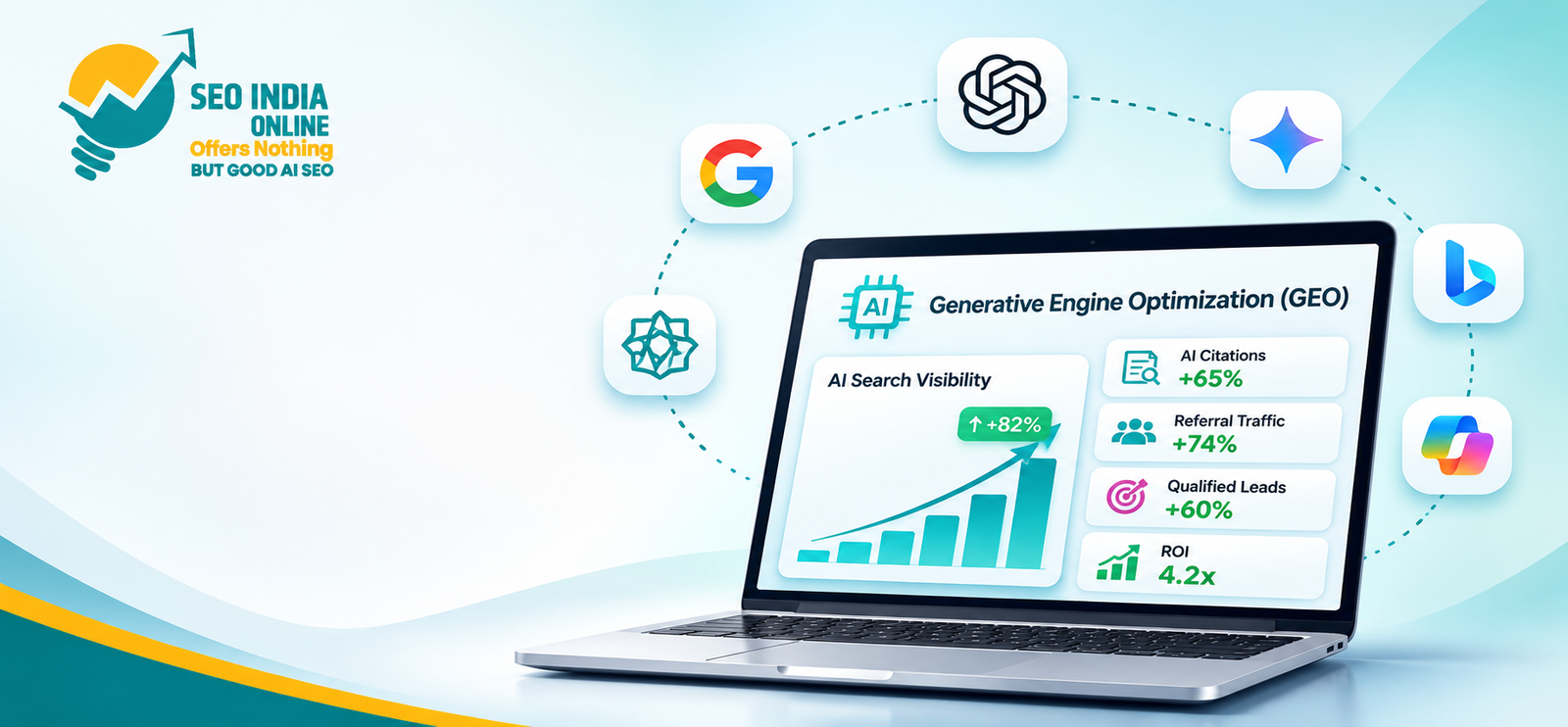

More than a billion people now ask ChatGPT a question every week, and Google’s AI Overviews reach over 2.5 billion users a month. Buyers get a full answer, and often a shortlist of brands, before they open a single website. That shift leaves every marketing team with one fair question: if we invest in GEO, what do we get back? This guide answers it with numbers, metrics, and realistic timelines.
Is GEO Worth the Investment for Businesses?
The way people look for information has changed quickly. They now turn to ChatGPT, Google AI Overviews, Gemini, Perplexity AI, and Microsoft Copilot to research products, compare services, and decide what to buy.
Traditional SEO improves your visibility in search results. GEO works toward a different goal: making your brand visible, relevant, and worth referencing inside AI-generated answers. Businesses invest in it because these answers now shape the shortlist before a buyer ever reaches a website.
That is also why rankings and traffic cannot measure GEO fully. A large part of its influence happens without a click. We treat GEO ROI as a mix of visibility, brand authority, qualified traffic, leads, and revenue. The key takeaway is that do not judge GEO by website traffic alone. Its value also comes from brand mentions, AI citations, assisted conversions, and the business opportunities that begin in AI search.
What Is the ROI of GEO (Generative Engine Optimization)?
GEO ROI is the measurable business value you earn from optimization work that improves your brand’s visibility and presence across AI-powered search and answer platforms. In simple terms, it compares what you spend on GEO with what the business gains from it. Some of those gains show up as revenue you can trace to a visit. Others show up earlier, as mentions, citations, and trust that make a later sale easier. GEO supports business growth in five main ways.
1. Increased Brand Visibility Across AI Platforms
The first return is simply being present. GEO increases the chance that ChatGPT, Gemini, and Perplexity mention your brand, and that Google AI Overviews include it. This matters most when people ask industry questions or compare products and services, because that is when a shortlist forms. A brand missing from those answers is missing from the decision, even if it ranks well on Google for the same topic.
2. More Qualified Website Traffic
AI platforms send fewer visitors than search engines, but those visitors arrive better informed. Some click a link inside an AI answer. Others research your brand in a chatbot first and visit later. Either way, they already understand what you offer. Retail analytics data from September 2026 shows AI-referred visits converting 90% better than other traffic, with 83% higher revenue per visit.
3. Improved Lead Generation and Conversions
Better-informed visitors act faster. We see this as AI-assisted inquiries, contact form submissions, demo requests, consultation bookings, product purchases, and direct calls or emails. The AI tool has already answered the early questions about fit, features, and price range. So the person who reaches your site is often confirming a decision, not starting one. That shortens the path between the first visit and a real conversation with your sales team.
4. Stronger Brand Authority and Trust
When relevant AI sources cite you often, include you in industry recommendations, and describe you the same way across platforms, buyers start to treat your brand as a safe choice. This authority builds on itself. One study of 75,000 brands found that those in the top quarter for web mentions received over ten times more mentions in AI Overviews than the next quarter. Being talked about earns more visibility.
5. Better Long-Term Marketing Efficiency
GEO work does not expire when a campaign ends. A clear, well-researched page is an asset that can be cited across several AI platforms for months. Each new piece also strengthens your topical authority, which helps every related page. Compare that with paid ads, where visibility stops the day the budget does. Over time, the cost of each visit, lead, and sale from GEO tends to fall.
How Does GEO Generate Business ROI?
GEO does not produce revenue in a single step. Each activity improves one part of how AI systems find, understand, and trust your brand, and those improvements add up to business results. It helps to see the link between the work and the outcome before you set a budget. Otherwise, it is easy to pay for tasks that sound technical but do not connect to anything a customer sees. The table below maps the main GEO activities to the impact you should expect from each.
| GEO Activity | Expected Business Impact |
|---|---|
| Entity optimization | Stronger brand recognition by AI systems |
| Content optimization | Higher chances of being referenced in AI answers |
| Schema implementation | Better machine-readable content understanding |
| Digital PR and brand mentions | Stronger brand credibility and authority signals |
| Expert-led content | Improved trust and information quality |
| Topical authority building | Greater relevance for industry-related queries |
| Technical SEO improvements | Better content accessibility and discoverability |
These activities work together. Entity work tells AI systems who you are. Content and schema help them read your pages correctly. Digital PR and expert-led content give them reasons to trust what they read. Technical SEO makes sure they can reach your pages in the first place. A single brand mention does not guarantee revenue. But when your brand keeps appearing at the moment customers research, compare, and decide, that repeated visibility can turn into inquiries, sales, and business growth.
Key Metrics to Measure the ROI of GEO
No single number can tell you whether GEO is working. Visibility without leads is only exposure, and leads without visibility data leave you guessing about the cause. We recommend tracking four layers together: visibility, engagement, conversion, and revenue. Each layer answers a different question, from “Are AI platforms talking about us?” to “Did that attention produce income?” The six metrics below cover all four layers.
1. AI Visibility and Brand Mention Rate
This metric shows how often your brand appears in AI-generated answers for relevant industry queries. Track brand mention frequency, AI visibility percentage, share of voice across AI platforms, competitor visibility, and whether you are included among recommended solutions. The math is simple. If your brand appears in 30 out of 100 relevant AI-generated responses, your brand mention rate is 30%.
2. AI Citation and Source Visibility
Here you track how often AI platforms cite or link to your website as a source. Measure the number of website citations, citation frequency across your target queries, the pages that earn the most citations, competitor citations, and citation growth over time. Mentions and citations are different things. A platform can mention your brand without linking to your site, and it can cite your page without recommending you.
3. AI Referral Traffic
Start by watching the visits that come from ChatGPT, Perplexity, Microsoft Copilot, Gemini (where it passes referral data), and any other AI discovery tool your audience uses. We look at five numbers here: AI referral sessions, engaged sessions, new users, engagement rate, and how each landing page performs. GA4 now has a default AI Assistant channel, which helps, but it misses two things. A click from Google’s AI Overviews or AI Mode still lands under Organic Search, and any visit that shows up with no referral data gets dumped into Direct. So whatever GA4 reports, read it as the minimum and not the full count.
4. AI-Driven Leads and Conversions
Traffic only matters if visitors do something meaningful. Count the form submissions, phone calls, demo requests, consultation bookings, product purchases, and qualified leads that come from AI platforms. We also suggest one low-cost addition: a “How did you hear about us?” field on your forms, with an AI assistant option. People remember when ChatGPT recommended you, even if analytics does not.
5. Assisted Conversions and Revenue
Not every AI-influenced customer converts on the first visit. Many meet your brand in an AI answer, leave, and return days later through a branded search or a direct visit. GEO earns its value early in that journey, so last-click reports undercount it. Track AI-assisted conversions, multi-touch attribution, conversion paths that include AI referrals, and revenue tied to AI referral sessions. Then compare customer acquisition cost for this channel against paid search and other sources.
6. Brand Search Growth
People who see your brand in an AI answer often search for it by name afterward. So rising AI visibility should show up as more branded search impressions, more branded clicks, more direct website traffic, and higher overall demand for brand-related terms. Search Console is the place to watch this. It now also includes a generative AI performance report that shows your impressions in AI Overviews and AI Mode.
GEO ROI vs Traditional SEO ROI: What’s the Difference?
SEO and GEO share the same aim, which is profitable visibility, but they are measured differently. SEO has more than two decades of settled metrics: rankings, impressions, clicks, and organic conversions. GEO measures presence inside an answer that changes with every prompt, and a good share of its impact never appears as a click. That makes its ROI harder to read, though far from impossible. The comparison below shows where the two differ most clearly.
| Evaluation Factor | Traditional SEO | GEO |
|---|---|---|
| Primary visibility | Search engine rankings | AI-generated answers |
| Visibility metrics | Keyword rankings and impressions | AI mentions and visibility share |
| Traffic measurement | Organic website traffic | AI referral traffic |
| Authority signals | Backlinks and topical authority | Brand mentions, citations and source credibility |
| Conversion tracking | Organic leads and sales | AI-assisted and AI-referred leads |
| Competitive analysis | SERP share of voice | AI answer share of voice |
| Measurement complexity | Relatively established | Still evolving |
What Factors Influence the ROI of GEO?
Two businesses can spend the same amount on GEO and see very different returns. The gap usually has little to do with luck. It comes from where each business starts, how crowded its market is, and how well the work is carried out. Knowing these factors in advance helps you set a fair budget, a sensible timeline, and a set of expectations your leadership team can accept.
1. Industry Competition
In highly competitive industries such as finance, software, and healthcare, many strong brands are already fighting for a few spots in each AI answer. Earning a place there takes more content, more authority-building, and sharper brand positioning. In a narrow or local market, the same effort goes further. Fewer brands have done the work, so AI tools have fewer trusted names to choose from when they answer.
2. Existing Brand Authority
A brand already known has a head start. That’s because AI systems pick up what they know about a company from the rest of the web, and years of press coverage, reviews, and online discussion make a name much easier to recognize and recommend. One study of 75,000 brands found that web mentions predicted AI visibility roughly three times more strongly than backlinks. None of this shuts newer brands out. It just means they should set aside real time to build that presence first.
3. Content Quality and Relevance
What AI tools want is content they can quote without second-guessing it. If a page is accurate, written by someone who knows the subject, and laid out clearly, it stands a better chance of being picked as a reference. There is solid evidence for this. A well-known university study on GEO ran tests across 10,000 queries and found that adding statistics, quotations, and clear sources lifted a page’s visibility in AI answers by up to 40%. Keyword stuffing, on the other hand, did nothing. In AI answers, depth beats sheer volume.
4. Technical SEO Foundation
AI platforms cannot cite what they cannot reach. Crawlability, indexing, internal linking, structured data, and content accessibility all support discoverability. Many AI crawlers also struggle with content that loads only through JavaScript, so key facts and answers should sit in the page’s HTML. If your technical base is weak, even excellent content stays invisible to these systems, and the return on everything else you do drops.
5. GEO Strategy and Execution
Scattered tasks produce scattered results. A complete strategy covers entity optimization, content improvements, digital PR, citations, and AI visibility tracking, and it puts them in the right order. Tracking comes first, because you need a baseline before you can prove progress. Execution quality matters as much as the plan. A strategy that looks impressive in a proposal but ships late, or only in part, will not move your numbers.
6. Conversion Experience
GEO can bring the right visitor to your door, but your website still has to do its part. Poor landing pages, weak messaging, slow load times, or complicated inquiry forms can waste that visit. This matters more with AI traffic because the volume is small and the intent is high. Every lost visitor is an expensive loss. Fixing the conversion experience is often the fastest way to raise GEO ROI.
How Long Does It Take to See ROI from GEO?
You need patience with GEO, and an honest agency won’t hand you a fixed date. Part of the work shows up fast and part of it takes months. Fix the technical issues and tidy up your content, and the way AI tools describe you can shift within weeks. Authority is slower, since mentions and citations from third parties only pile up over time. Revenue arrives last of all because buyers research, go away, come back, and then decide. That’s why we suggest judging different things at different stages instead of everything at once. The table below lays out what to evaluate in each period of a GEO program.
| Period | What Businesses Should Evaluate |
|---|---|
| First 1 to 2 months | Baseline AI visibility, competitor analysis, content and technical audit |
| Months 3 to 4 | Content improvements, initial brand mentions, citation monitoring |
| Months 5 to 6 | Visibility trends, referral traffic, qualified inquiries |
| Months 6 to 12 | Conversion patterns, assisted revenue, business impact |
Read these as indicative evaluation periods and not as guaranteed timelines. How your own results play out depends on the authority your website has today, how crowded your industry is, the way each AI platform behaves, and how well the work is carried out.
How Can Businesses Improve the ROI of GEO?
1. Create Content Around Real Customer Questions
People talk to AI tools in full sentences. They ask specific questions, request comparisons, and describe problems in detail. Build your content around those real prompts. Your sales calls, support tickets, and site search logs are the best sources, because they show the exact words customers use. Then answer each question directly in the first lines of the page, and add the supporting detail below. Pages written this way are easier for AI tools to quote, and more useful for human readers too.
2. Strengthen Brand Entity Signals
An AI system pieces together its idea of your brand from many different sources. When your name, services, location, or key facts change from one place to the next, that idea turns fuzzy. The fix is consistency. Make sure your website, business profiles, directories, review platforms, and authoritative third-party sites all carry the same information, and give your About page and organization details an extra check. Once every source tells the same story, AI tools can describe you correctly and feel safer recommending you.
3. Build Topical Authority
One strong article will not make you an authority. AI tools favor brands that cover a subject from every angle. Create interconnected content clusters around your core products, services, and industry topics, with a main page for each theme and supporting pages for the related questions. Link them together clearly. Over time, this depth signals that your site is a reliable source for the whole topic, which makes you relevant for many more industry-related queries than a single page could reach.
4. Optimize Content for AI Understanding
Make your pages easy to read for both people and machines. Use descriptive headings, clear answers, factual statements, expert insights, tables, and FAQs. Each section should make sense on its own, because AI tools often lift a single passage, not the whole page. Add specific numbers and name where your facts come from. Controlled research shows that statistics and credible quotations make content more likely to appear in AI answers. Vague claims give an AI system nothing solid to repeat.
5. Implement Relevant Structured Data
Add Organization, Article, Product, Service, or whichever schema types match what is really on the page. Structured data makes it easier for machines to read your content the right way, and it supports rich results in search. Just don’t expect too much from it. Google has said its AI features need no special schema, and when nearly 1,900 pages were tested in 2026, adding markup by itself hardly moved AI citations. We see schema as the groundwork under everything else you do, never as a shortcut to getting cited.
6. Improve Digital PR and Brand Mentions
AI systems give more weight to what other people say about you than to anything you say about yourself. So the goal is to earn relevant mentions and citations from authoritative industry websites and publications, and the things that earn them are original data, expert commentary, useful tools, and real customer stories. Reviews and community discussions help as well. Here, quality and relevance count for far more than numbers. Mentions produced in bulk add very little, and Google’s own guidance tells brands to stay away from inauthentic mention campaigns. A single mention in a respected trade publication can be worth more than dozens of weak ones.
7. Monitor AI Search Performance
Regularly test your most important queries across ChatGPT, Gemini, Perplexity, and Google AI Overviews. Use a fixed set of prompts so you can compare results over time, and run each prompt several times, because answers vary from one attempt to the next. Record whether you appear, how you are described, and which competitors show up beside you. Check accuracy as well. If an AI tool states something wrong about your business, trace the source and correct it there.
8. Connect GEO With Conversion Tracking
Visibility reports alone will not win budget approval. Use GA4, Google Search Console, CRM data, and lead attribution together to see actual business outcomes. Tag leads by source in your CRM so you can follow an AI-referred visitor all the way to closed revenue. Expect some gaps. For about a week in October 2026, many ChatGPT links stopped passing referral data, and those visits showed up as Direct traffic. Combining several data sources protects you from blind spots like that.
Is GEO Worth the Investment for Small Businesses and Enterprises?
Yes, in both cases, though the reasons differ. A small business uses GEO to get noticed in places where bigger budgets used to win. An enterprise uses it to protect and extend a position it already holds. The priorities, scale, and metrics change with size.
For Small and Medium-Sized Businesses
It is often the smaller business that gets the most out of GEO. Because AI tools answer very specific questions, a focused company can compete for niche industry queries the big brands never bother with. There are other gains too: stronger credibility, better visibility for particular services and locations, and relevant inquiries that don’t rely entirely on paid advertising. The research backs this up. In controlled tests, the websites that ranked lower were the ones that gained the most visibility from GEO improvements. Be clear, be specific, and be helpful, and you can earn a spot next to much bigger names.
For Enterprises
For large organizations, GEO is about scale and control. It supports brand visibility across every major AI platform, competitive share-of-voice monitoring, and product and category discovery. It also plays a growing part in reputation management, since AI tools may describe your brand to millions of people using outdated or incorrect sources. Enterprises with many locations or international markets need consistent visibility in each one. Handled well, GEO becomes part of a long-term organic acquisition strategy that reduces reliance on paid media.
How to Choose a GEO Agency That Focuses on ROI?
Many agencies now offer GEO, but their depth varies widely. Some have simply renamed their SEO packages. Before you sign, check how an agency plans to connect its work to your revenue, not only to visibility charts. These seven points will help you compare your options.
Experience in SEO, AEO, and GEO
GEO rests on SEO, and it overlaps with AEO (answer engine optimization). An agency that understands only one of the three will leave gaps. Ask how long the team has worked in search, and how its methods have changed since AI answers arrived. Request examples that show results in both classic search and AI platforms. Real experience shows in the details. A capable team can explain what it tried, what failed, and what it changed afterward.
Understanding of AI Search Platforms
ChatGPT, Gemini, Perplexity, Copilot, and Google AI Overviews do not behave the same way. Each one draws on different sources, and each handles links and citations differently. A good agency knows these differences and plans for them, without applying one checklist to every platform. Ask which platforms matter most for your audience, and why. If the answer is the same for every client, the agency is probably working from a template and not from research.
Ability to Track Brand Mentions and Citations
You cannot improve what you do not measure. The agency should track a defined set of prompts across platforms and report your mention rate, citations, cited pages, and competitor visibility. Ask how often it runs each prompt. AI answers change from one attempt to the next, so a single test tells you very little. Be careful with anyone who reports a fixed “AI ranking position”. Research has shown that such positions are mostly noise.
Content and Entity Optimization Capabilities
Tracking shows the gaps. Content and entity work closes them. Look for a team that can restructure existing pages, write clear and well-supported answers, and keep your brand information consistent across the web. Ask to see before-and-after examples of pages it has improved. Check whether subject experts are involved in the writing, because thin, generic content does not earn citations. The agency should also handle third-party profiles, since much of what AI knows about you sits outside your website.
Technical SEO Expertise
AI visibility depends on a sound technical base. The agency should audit crawlability, indexing, site speed, internal linking, and structured data, and confirm that AI crawlers can access your important pages. Ask whether it checks how your pages render without JavaScript, and whether your robots.txt file blocks any AI crawlers by mistake. These issues are simple to fix once someone finds them. Left alone, they can quietly cancel the value of all your content work.
Transparent Performance Reporting
Good reporting tells you what was done, what changed, and what happens next. Expect regular reports covering tracked prompts, mentions, citations, AI referral traffic, and leads, along with a plain explanation of each number. The agency should also be open about the limits of current tools. AI attribution is still imperfect, and anyone claiming complete precision is overselling. You should have direct access to your own data, and never have to depend on screenshots.
Focus on Qualified Leads and Business Conversions Rather Than Vanity Metrics
A higher mention count feels good, but it does not pay salaries. The right agency ties its work to qualified leads, sales conversations, and revenue. Ask how it defines a qualified lead for your business and how it will connect AI visibility to your CRM. It should be willing to set targets around business outcomes and to tell you plainly when a tactic is not working. Visibility is the starting point. Conversions are the reason you invest.
Before a reliable agency changes anything, it will record your baseline performance, agree on measurable KPIs with you, and tie each optimization activity to a business objective. A proposal that leaves out any one of those three steps should be read as a warning sign.
Conclusion
Getting your brand mentioned by AI platforms is only a small part of what GEO is for. The real value comes from shaping customer decisions, earning trust, bringing in qualified visitors, and opening up business opportunities you can actually measure. That only becomes clear with a framework that connects AI visibility to leads, conversions, and revenue. Start with a baseline, track the right metrics, and review the trend every quarter. If you would like to know where your brand stands today, our team at SEO India Online, a Generative Engine Optimization Agency in India and AI SEO company in India, can run a free AI visibility audit and show you the gaps worth fixing first.

Rajive Rana
Rajive has spent 18 years building search programmes for brands across India, the UK and the US — from local service businesses to enterprise ecommerce. He writes about the parts of SEO that survive algorithm cycles, and leads the AI visibility practice at SEO India Online.
Connect on LinkedIn