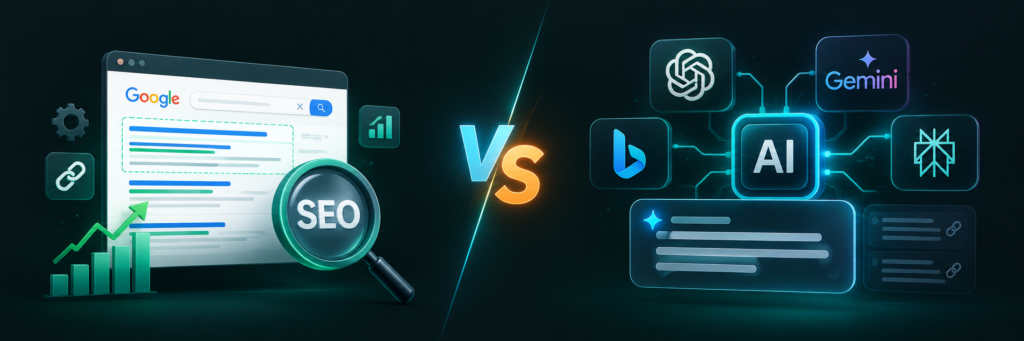


Want your brand to show up when someone asks an AI a question? It starts with making your brand easy for these systems to find, understand, trust, and quote. ChatGPT, Google AI Overviews, Microsoft Copilot, and Perplexity don’t all pull from the same places, so where and how you appear can look very different from one to the next. The reason to care is simple. People are making choices inside these answers, often before they ever click through to a website. That’s not the same as ranking on a results page. Below are the practical steps that help, and how to earn more mentions and citations.
How to Improve Your Brand Visibility in AI Search Results
1. Understand How AI Search Platforms Discover Your Brand
Think about how an AI actually builds an answer. It leans on search indexes, your own site, sources it already trusts, and whatever else it can find. So your website matters, but so does everything said about you elsewhere. Ask two AI tools the same question and you may get two different pictures, which is why one check never tells you enough. Start simple. Search your brand, your products, and the questions your buyers ask, across the tools they use.
2. Optimize Your Website Content for AI Search
Clear, well-structured content is at the core of AI SEO, helping search systems understand what your brand offers and when your content is relevant. When a page explains one thing well, an AI can work out what you do and when to bring you up. Give every service or product a home of its own, and say plainly who it’s for and what it fixes. Answer the questions customers ask. Keep your headings honest, your paragraphs tight, and your facts steady across the site. Then reread your main pages and check that each one earns its place.
3. Create Content That Directly Answers User Questions
People arrive with questions long before they buy. Map those out, from the early what is this stage to the head-to-head comparisons and the final decision. Then answer each one straight away, near the top, so nobody has to dig. Skip the fluff and show your work with real examples and proof. FAQs help when they solve something genuine, not when they pad a page. When a detail goes outdated, fix it fast. Keep a running list of these questions.
4. Strengthen Your Brand’s Topical Authority
Authority isn’t a claim you make; it’s a pattern you build. Publish enough around your core subjects and AI starts to see what you know. Stay close to your products, services, and industry, and pair each service page with content that teaches something. Cover the messy questions, the edge cases, the reasons people hesitate. Connect related pages with links that describe where they lead. Then look hard at your field and ask whether your site really answers what customers want.
5. Improve Your Website’s Technical SEO
None of this works if the machines can’t read your pages. Make sure the important ones can be crawled and indexed, then check the important elements like robots.txt, sitemaps, canonical tags, indexing rules. Repair broken links. Speed the pages up where they lag. Confirm the site behaves the same as desktop on a phone. Clean URLs and plain, readable HTML help more than people expect. Just remember that being reachable gets you considered, not quoted. Run this audit before you pour real effort into more content.
6. Use Structured Data to Clarify Your Brand Information
Schema is how you hand a search engine the facts in a clean form it won’t misread. Use Organization or LocalBusiness markup where it fits, and add Product, Service, Article, or FAQPage tags only when they mirror what someone actually sees. Keep your name, address, and contact details identical everywhere, then validate the code and clear any errors. Never mark up something that isn’t on the page. Schema clarifies things; it won’t promise you a mention in an AI answer.
7. Build a Strong and Consistent Brand Presence Across the Web
What lives off your own site shapes how AI sees you too. Keep your profiles accurate on the directories and platforms that matter, with the same story told the same way in each. Earn real mentions through publications, communities, and sites people respect, and put your expertise out there in interviews, guest pieces, and original research. One thoughtful reference beats a hundred throwaway ones. Go check where you already show up, fix what’s wrong, and chase the openings worth chasing.
8. Earn Relevant, High-Quality Backlinks and Brand Mentions
Good links still count, just not the way spammers hope. Aim for backlinks from sites in your world, and give people something worth linking to, whether that is research, a tool, or a useful take. Build real relationships with editors and experts, and let the mentions come honestly. Keep an eye out for references you can correct or flesh out. Links and mentions aren’t a guaranteed AI lever; their worth depends on where they sit and how relevant they are.
9. Make Your Brand Information Easy to Verify
AI trusts what it can confirm. Give it an About page that explains who you are, plus company details and service descriptions that hold up. Show your credentials and the experience behind them. Put out case studies with proof, not just praise. Keep your pricing, policies, and product facts current, and hunt down anything that contradicts itself across your profiles. Here is the real test: could a stranger work out what you do and check your claims without calling you?
Also, check – Can AI SEO Tools Replace SEO Experts?
10. Monitor Your Brand’s Visibility Across AI Search Platforms
You can’t improve what you never look at. Watch how often your brand turns up in AI answers, and note the citations and links coming back your way. Track the queries that matter for your services and products, and jot down which pages and outside sources get the credit. Compare the tools, because their answers won’t line up. Set a baseline with a fixed list of questions, then run that same list on a schedule and watch the numbers shift.
How to Measure the Results of AI Search Optimization
| Metric | What to measure |
|---|---|
| AI brand mentions | How often your brand appears in relevant AI answers |
| AI citations | How often AI platforms reference or link to your website |
| Query coverage | How many relevant customer queries include your brand |
| Source visibility | Which website pages and external sources are referenced |
| Referral traffic | Visits coming from AI search platforms |
| Conversions | Leads, enquiries, or sales generated through AI-referred traffic |
Don’t read any of these numbers in isolation, and don’t judge them on a single day. Watch the trend across a few of them instead. AI answers shift with the platform, the wording, and the moment, so what you see in one tool won’t match another. No single figure proves your visibility jumped everywhere at once. The honest measure is the whole picture, tracked patiently over time.
Conclusion
There’s no single trick behind AI visibility. It comes from useful content, a site that works under the hood, brand details that stay straight, honest mentions around the web, and the discipline to keep watching. Nothing here pays off alone, and nothing pays off by Friday. So begin with what’s in front of you. See how AI describes you now, spot the gaps your customers would notice, and fix the pages they lean on first. The rest builds from there.
Not sure how AI search sees your brand right now? At SEO India Online, we dig into your visibility, close the gaps, and build the content and authority these platforms actually trust. Talk to our team, and let us make your brand the name that comes up first.

Rajive Rana
Rajive has spent 18 years building search programmes for brands across India, the UK and the US — from local service businesses to enterprise ecommerce. He writes about the parts of SEO that survive algorithm cycles, and leads the AI visibility practice at SEO India Online.
Connect on LinkedIn